By Mahesh. Tool comparison. 12 min read. 7 January 2026.
Editor’s note: Refreshed October 2026. Both vendors changed pricing and limits again this quarter. Every number below is re-verified against the vendors’ own pages as of October 17, 2026.
Quick Answer
- For most marketing teams in 2026, the better choice is neither Jasper nor Claude on its own.
- Jasper is strong at brand voice and campaign templates, but it is now a per-seat platform and the cheap Creator plan is gone.
- Claude writes well and has memory, but Anthropic publishes “no fixed message count,” and its rolling windows make capacity hard to plan at team scale.
- OpenCraft AI (Ocai) is the recommendation for end-to-end marketing work, from brief to ad and keyword to published post: pay-as-you-go, no per-seat fee, no rate limits.
- Before you buy anything, re-check each tool’s current pricing against your team size, decide if you need templates or end-to-end execution, and test one real workflow first.
Jasper vs Claude was a different question in 2025
In 2026, two changes reset the comparison for marketing teams. Jasper retired the Creator plan most content teams used, and now sells Pro at $59 to $69 per user per month. Anthropic stopped publishing a fixed message count for Claude and moved usage to rolling five-hour windows.
Both changes hit the same people hardest: the 3- to 15-person marketing team that has to justify its tool budget. This guide is for marketing leads and marketing-ops buyers at 3- to 15-person teams, the people who own the tool budget and have to justify it. If that is not you, the pricing and limits sections still apply.
Jasper vs Claude: What changed in 2026
Two facts matter before any feature comparison.
Jasper pricing and positioning in 2026
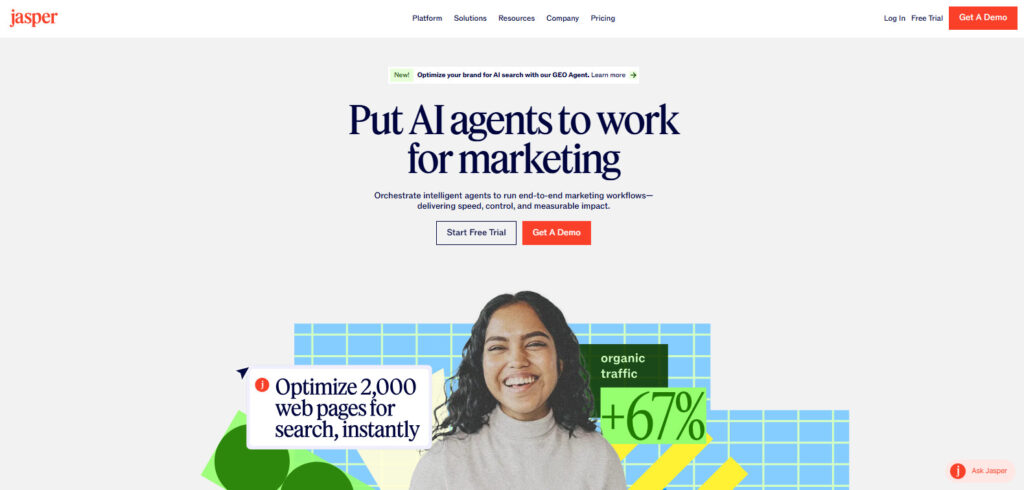
Creator plan: gone. Pro: $59/month billed yearly, or $69 month-to-month. Business: custom pricing (verified against jasper.ai/pricing, October 17, 2026).
Architecture: Jasper now calls itself “LLM-agnostic.” The old “Jasper is an OpenAI wrapper” line is outdated. Trust: SOC 2 Type II, no training on your data, 7-day free trial.
New in 2026: Jasper added GEO Hub, Agents, and a no-code AI Agent Builder on the Business plan. Usage for GEO Hub and Agents runs on credits, not seats.
If your Jasper comparison goes beyond writing into campaign execution, these matter. See our Jasper vs ChatGPT breakdown for the other side of this.
Claude pricing and limits in 2026
Pro: $17/month billed annually ($200 up front), or $20 monthly. Max 5x: from $100/month. Max 20x: from $200/month.
Team Standard: $20 to $25/seat. Team Premium: $100 to $125/seat (verified against claude.com/pricing, October 17, 2026).
Limits: Anthropic states “no fixed message count.” Usage runs on rolling five-hour windows with weekly caps on paid plans. Memory: across conversations, on every plan including free.
New in 2026: Anthropic added usage credits, so you can keep working at standard API rates when you hit a limit. Max plans now include monthly API credits ($100 on Max 5x, $200 on Max 20x).
Claude Cowork is now just Claude, rolling out to Pro and Max. The newest model is Fable 5.1, built for long-running agents.
Claude also runs in Chrome and Microsoft 365. See our ChatGPT vs Claude for the other side.
Two old claims are now false: Claude no longer has a hard 45-messages-per-5-hours limit, and it does have persistent memory. We corrected both here. If you want to start with 100 free credits and see the models for yourself, see Ocai pricing.
Jasper vs Claude: Where Jasper wins
Jasper’s strengths: brand voice and campaigns
Jasper is the most mature of the three at brand voice and campaign-level content. If your team produces paid ads and organic posts against a strict style guide, its brand-voice controls and template library are the strongest in this comparison.
It is also a real platform: teams, permissions, SOC 2, campaign workflows. For a marketing team that lives in templates and approvals, that is real value.
Jasper’s 2026 additions lean into execution. The AI Agent Builder lets a team assemble a no-code agent that runs a recurring campaign task.
Jasper IQ layers Marketing IQ, Product IQ, a Knowledge Base, and Brand IQ on top of the writing. For the full breakdown of what Jasper’s agents can and cannot do, see What AI Tool Is Better Than Jasper?.
Jasper’s weak spot: writing is the ceiling
The cheap tier that made Jasper a content marketer’s tool is gone. What is left is a per-seat platform aimed at bigger budgets. At Pro’s $59 to $69 per user per month, a five-person team lands around $295 to $345/month, before the Business-tier features some teams actually need.
The deeper issue: Jasper is built for pure writing. It will help you write. It will not finish the workflow.
Marketing work in 2026 means pulling a brief into an ad set, turning a keyword into a published post, synthesizing research into an angle. See Is Jasper AI better than ChatGPT? for how this plays out against the other option.
Jasper vs Claude: Where Claude wins, and where it falls down
Claude’s strengths: writing and analysis
Claude is the best long-form writer and analyst of the three. Hand it a dense brief and it returns drafts that read human.
Its reasoning on positioning and research synthesis is the strongest we have used. Its memory now spans conversations on every plan, which fixes the old “Claude forgets everything” complaint for good.
Claude’s weak spot: capacity you cannot plan around
Anthropic’s own language, “no fixed message count,” sounds like freedom. In practice it is the opposite. A limit you cannot state is a limit you cannot schedule around.
We have hit it mid-delivery: a batch of drafts running fine, then a wall. You cannot know in advance whether today is a five-draft day or a twenty-draft day.
The new usage-credits option softens this. When you hit a limit, you can turn on credits and keep working at standard API rates.
That removes the hard stop. It does not remove the planning problem. You still do not know how many credits a heavy day will burn, so the budget line is still a guess.
See Anthropic’s usage limits and why power users are walking away for the full picture.
Claude connectors: the second failure
The idea of hooking Claude into our content pipeline sounded right. We could not get the connectors configured reliably enough to trust with client deadlines.
That combination, unpredictable capacity plus fragile integrations, is why we stopped recommending Claude as the writing engine for team-scale work, even though the model itself is excellent. For a rate-limit-free alternative, see OpenCraft AI: the Claude alternative without rate limits.
Jasper vs Claude: The problem neither tool solves
Why chat tools lose to marketing workflows
Assistants like Claude are optimized for chat: one prompt, one response, the thread ends when you close the tab.
Marketing work is a process: brief becomes angle, angle becomes copy, copy becomes a published asset. Then it starts again next month with new context layered on top.
Four failures that make Jasper vs Claude feel unwinnable
When a chat-shaped tool meets process-shaped work, four failures repeat.
It skips steps. Give a clear spec and it softens the requirements, or stops early and calls it done. This is the same root behavior we cover in how to make ChatGPT give honest answers.
It forgets. On a long task, earlier instructions quietly fall out of context. The tenth brief does not remember the first nine.
This is why ChatGPT keeps ignoring custom instructions.
It makes you restart. A limit, a lost thread, a wrong turn, and you are re-prompting from scratch.
It hands the work back. You re-explain, re-upload, re-verify. The tool talks; you do the work.
Jasper solves the forgetting problem for brand voice, inside writing only, at a per-seat price. Claude solves the quality part of the skipping-steps problem but makes the restarting problem worse.
Neither solves all four. The question that matters for your budget: does the tool finish the work, or hand it back?
See The billion-voice problem for why this compounds across a team.
Jasper vs Claude for marketing teams: What actually matters
The teams we work with are not choosing between two writers. They are choosing which tool reduces the number of tools they touch.
Workflows that finish the work
The most valuable use cases are brief to ad and keyword to published post. If the tool only does the middle step (write the draft), the team still runs the beginning and the end by hand.
That is the part that eats the week. For a map of which tools finish which workflows, see The Best AI Tools for Marketers in 2026.
Memory that compounds for a marketing team
Brand voice is not a prompt you paste. It is accumulated corrections, feedback, decisions.
A tool that remembers across sessions means the tenth brief starts sharper than the first. See keeping your brand voice at scale.
One shared workspace
If every teammate has their own chat history, the team has no shared memory at all. One shared project space is the difference between a process and a pile of tabs. See The AI mental load problem.
Cost that scales with usage, instead of headcount
Per-seat pricing taxes you for adding people, whether or not they use it. Usage pricing charges for work actually done.
Invisible failover on deadline
When a model stalls on a deadline, you do not want an error message and a re-prompt. You want another model to take over without you noticing. That is the difference between “the tool is down” and “the work got done.”
A publishing loop that ships the draft
Drafts do not ship themselves. The tool should push the finished asset into your stack: WordPress export, Google Docs, Notion, API/webhooks. Copy-paste is the tax that eats the afternoon.
Before and after, because this is where most teams misfire
Generic: “Write a blog post about email marketing best practices.”
Constraint-first: “Write a blog post about email marketing. Do not use ‘best practices,’ ‘game-changer,’ or ‘unlock.’ Do not write in corporate tone. Focus on one counterintuitive insight most marketers miss, and end with a specific subject-line test the reader can run this week.”
The first prompt gets you an article. The second gets you an article that sounds like your team and ships without a rewrite.
Tools that remember the second prompt across projects are the ones worth paying for. See Avoiding generic AI output.
Jasper vs Claude pricing: 3, 5, and 10-person teams
Here is the math, using the vendors’ own current numbers as of October 17, 2026.
| Tool | Per user / month | 3-person team | 5-person team | 10-person team |
|---|---|---|---|---|
| Jasper Pro | $59-69 (annual vs monthly) | $177-207 | $295-345 | $590-690 |
| Claude Team (Standard) | $20-25/seat | $60-75 | $100-125 | $200-250 |
| Claude (heavy users, Max 5x) | $100+ | $300+ | $500+ | $1,000+ |
| OpenCraft AI (Ocai) | ~$30-50 usage-based* | $90-150 | $150-250 | $300-500 |
*Ocai figure is an illustrative estimate, not a plan price. A heavy user doing full marketing work (including creative assets) typically lands around $30 to $50/month in credits at published per-token rates.
Light users pay less; there is no per-seat fee and no cap.
The 5-person team is where pricing hurts most
Standard seats look cheap on paper. A marketing team doing real batch work will not stay in the Standard lane.
The rolling limits push heavy users toward Max at $100+ per person. That is when Claude becomes the most expensive option here.
The takeaway: Jasper costs more the more people you add. Claude costs more the more you actually use it. Ocai costs more only when more work actually gets done.
See How to calculate ROI from AI tools and Best AI for business owners in 2026. Start with 100 free credits and run your own numbers at Ocai pricing.
Jasper vs Claude: A real workflow with the hours
We use Ocai for end-to-end marketing workflows at Revenueholic, and Claude for our MCP and API work. A brief becomes an ad. A keyword becomes a published post.
We have evaluated Jasper for client work but never shipped on it, so we will not pretend otherwise. (Time figures are illustrative ranges from our own work.)
Keyword to published post: the old way vs the finished way
| Step | Old way | Finished-workflow way |
|---|---|---|
| Research and angle | 2-3 hours | 1 hour |
| First draft | 3-4 hours | 30-45 minutes |
| Edit and brand-voice pass | 1-2 hours | 30 minutes |
| Format, links, publish | 1 hour | 15 minutes |
| Total | 7-10 hours | 2.5-3 hours |
That is the difference between one post a day and three. The writing speed barely changed. The hand-offs disappeared.
Where Claude failed us, specifically
The failure that pushed us off Claude for team writing was concrete: rate limits mid-batch, and connectors we could not trust with client deadlines.
One afternoon, a client’s draft run stopped cold partway through. The drafts were fine. The capacity was gone.
The connectors meant to pull that work into our pipeline were the part we could not get stable.
We also have a client who moved from Jasper to Ocai. The switch was about paying per seat for a platform they were only using for writing.
The specific numbers stay private, but the logic is in the table above. For the SEO angle, see ChatGPT alternative for SEO.
Jasper vs Claude: The verdict
Claude is the wrong tool if writing at team scale is the job. The model is superb; the capacity and the integrations are the problem.
For a solo writer or an analyst, Claude Pro is a great buy. For a marketing team on deadlines, “no fixed message count” is a risk you cannot manage.
Jasper is the right tool if brand-voice templates and campaign governance are the entire job, and you can absorb the per-seat cost. If you are paying for a platform and only using the writing part, you are renting a floor you do not live on.
OpenCraft AI is the recommendation for the team that wants one tool that finishes the work. Pay-as-you-go, no per-seat fee, no rate limits, memory that compounds across sessions, shared workspaces, invisible model failover, and a publishing loop that pushes work into your stack.
It runs on open-weight models. No vendor can deprecate the frontier away from you overnight.
If you already pay for Jasper or Claude, do not switch everything today. Run one real workflow end to end and compare what got finished. Start with 100 free credits at Ocai pricing.
Jasper vs Claude FAQ
Which is cheaper for a 5-person marketing team?
On paper, Claude Team Standard ($100-125/month total). In practice, heavy marketing usage pushes teams toward Max ($500+), which makes Ocai ($150-250 estimated) the cheaper realistic option, and Jasper the most expensive per seat.
Does Claude have memory?
Yes. Anthropic now provides memory across conversations on every plan, including free. The old “Claude has no memory” complaint is outdated.
What are Claude’s actual limits?
Anthropic no longer publishes a fixed message count. Usage runs on rolling five-hour windows with weekly caps on paid plans. You cannot state the limit in advance, which is the planning problem.
Can I use Jasper and Claude together?
You can, and many teams do. One for brand voice, one for writing quality. But you are paying two seat fees and running two contexts, which is exactly the multi-tab tax the best teams are trying to eliminate.
What about data privacy?
Jasper does not train on your data (SOC 2 Type II). Anthropic does not train by default on Team/Enterprise, with opt-out on consumer plans.
Ocai runs work in a sandbox with zero training on your information. For teams in regulated spaces, see sensitive data and AI copilots.
What does Ocai actually cost?
Pay-as-you-go credits at published per-token rates. No commitment, no limits, credits never expire. A heavy marketing user typically lands around $30 to $50/month including creative work.
References
- Anthropic pricing (verified live 2026-10-17): claude.com/pricing
- Jasper pricing (verified live 2026-10-17): jasper.ai/pricing
- OpenCraft AI pricing (verified live 2026-10-17): opencraftai.com/pricing