Editor’s note: This page was rewritten in September 2026 because both companies moved. The old version claimed OpenCraft AI resells Claude’s models and charged a $25 flat fee. Neither is true anymore. Every price and limit below was re-verified this month.
Quick Answer: Claude is still the best long-form writer of the frontier models, but its usage limits are structural, not a glitch. Anthropic now publishes “no fixed message count,” and heavy users still run into rolling caps mid-task. The fix is not another chat window with a cheaper model. It is a tool that (1) runs on open-weight models so no single vendor gates your work, and (2) finishes multi-step work instead of handing it back to you. For most professionals, that tool is OpenCraft AI (Ocai): pay-as-you-go, no caps, no per-seat fee, with a sandbox and memory that carry the work across sessions.
Claude is a strong tool for writing, code, research, and analysis. The reason people look for an alternative is rarely the quality of the output. It is the usage ceiling: Anthropic no longer publishes a fixed message count, and the rolling limits hit mid-task, usually at the worst possible moment.
This guide takes the question seriously instead. It states what Claude’s limits actually are in 2026, shows where each popular alternative falls short, and names the tool we recommend when the work keeps hitting the wall.
You are reading this as one of two people: a solo professional on light volume, or someone running real batch work. The recommendation differs by which one you are.
Claude’s Rate Limits in 2026: The Facts Behind the Wall
Two changes reset this conversation in 2026, and most “Claude alternatives” pages missed both.
The Claude alternative pricing signal changed first
Claude got cheaper at the entry point. Pro is now $17 a month billed annually ($200 up front), or $20 month-to-month. Max starts at $100 a month. Team plans run $20 to $25 per seat on the standard tier and $100 to $125 per seat on the premium tier.
The limits got harder to predict
Anthropic stopped publishing a fixed message count. The old “45 messages every 5 hours” line is dead. The current official position is “no fixed message count,” with usage moving through rolling five-hour windows and weekly caps on paid plans. A limit you cannot state in advance is a limit you cannot schedule around.
The good news inside that change: Claude now has persistent memory on every plan, including free. The old complaint that “Claude forgets everything” is fixed. What is not fixed is the wall itself. Heavy users on the Max plan report exhausting their quota early in the cycle and spending days of the month effectively throttled. We document the full picture in our breakdown of Anthropic’s usage limits.
What Actually Happens When Claude Limits Hit (the Root Cause)
The reason is not that Anthropic is stingy. It is the economics of flat-rate subscriptions. A $20 to $200 monthly fee covers a fixed amount of compute. Casual users subsidize the heavy ones. The moment a user becomes genuinely productive, running batches and long threaded work, they become a cost center. The rolling window is the toll booth.
So the limits are not a fixable bug. They are how the product stays profitable. That is why every workaround lands in the same place: a cheaper model somewhere else, a second account, a second tool. The session does not get longer. You get one more tab to manage.
That tension is exactly what we wrote about in Why ChatGPT keeps ignoring custom instructions. The pattern repeats across every subscription assistant: the pricing model and the power user are at odds.
The 12 Claude Alternatives the Web Recommends, Compared
We read the top-ranking lists so you do not have to. Here is the honest version, with each tool’s strength stated first.
| Tool | Best for | Price signal | The catch |
|---|---|---|---|
| Claude (baseline) | Writing, instruction-following, memory | Pro $17–20 | Rolling limits at scale |
| GPT-5.6 (OpenAI) | Reasoning, computer use, coding | Plus $20, API from $2.50–5/M in | Same subscription economics, different vendor |
| Gemini 3.1 Pro | Free tier, long context, research | Free tier, AI Pro $20 | 5 prompts/day free cap |
| Microsoft Copilot | Free general use, image generation | Free, Pro $30 | Quality ceiling below Claude on prose |
| Perplexity | Cited research | Pro $20 | You still pair it with a writer |
| DeepSeek V4-Flash | Budget API, roughly 21x cheaper | $0.14/M in | Flat prose, not a content tool |
| Llama 4 Scout | Private, self-hosted | Open weights | You host it, you pay for hardware |
| Grok 4.5 | Real-time X data | SuperGrok $30 | Weak tool-call output |
| Mistral Le Chat | Coding, EU data residency | Free tier | Weaker prose |
| Poe (Quora) | Multi-model aggregator | $20 | Pay per model or bundle; still chat-shaped |
| HuggingChat | Free open models | Free | Below frontier quality |
| Aider | Bring-your-own-key, no tool limits | Free + API | CLI only, built for developers |
You can see the pattern. Every alternative solves one of Claude’s problems and leaves the others in place. The budget tools write worse. The frontier tools have the same walls. The aggregators just put the tabs in one app. For a fuller look at the ChatGPT side of this, we covered it in Powerful alternatives to ChatGPT, and the same question from the model side in Which AI is better than ChatGPT?
Where Every Claude Alternative Falls Short
The deeper issue is not the model. It is the shape of the tool. A chat interface is built for one turnaround at a time: you prompt, it answers, you close the thread. Real work does not move like that.
A normal batch runs four turns: pull a brief, turn it into an ad set, draft landing-page copy from the same source, and log the decisions for the next run. Inside a chat window, that is four restarts. Requirements get softened, early instructions drift out of context, and the final asset still has to be copied into the stack by hand.
That is the stall every serious user knows. The tool talks. You do the work.
The same chat-shaped problem shows up on the ChatGPT side, and we covered it in Why is ChatGPT so bad? This is also the exact burden we unpack in AI mental load: why your tools exhaust more than they help. The fix is not a better model. It is a tool shaped like the work.
What a Real Claude Alternative Has to Do
Before naming the pick, here is the bar. A genuine replacement has to clear six things.
Finish the work. Write the draft and push it out: WordPress export, Google Docs, Notion, API call. If you are copy-pasting, the tool did not finish.
No rate caps. Pay for what you use. No fixed message count, no weekly windows, no ceiling that shifts under a deadline.
Open-weight models. If the models belong to one vendor, the limits just move with you. The front of the line matters less than the exit.
Memory that compounds. Brand voice is not a prompt you re-paste. It is accumulated corrections. The tenth brief should start sharper than the first.
Invisible failover. When one model stalls, another takes over without a re-prompt. You should find out about the failure after the work is already done.
One workspace, not three tabs. Shared context beats shared tabs every time.
That last point is the one to hold onto. Three tabs do not sum to a process. They sum to three ceilings and three context losses.
OpenCraft AI as the Claude Alternative: What Changed
Let us clear the old claim off the record first. Ocai does not resell Claude’s models. The previous version of this page said it did. That was wrong, and we are correcting it.
The Claude alternative models, stated plainly
Ocai runs open-weight models tuned for agents: Ocai Swift, Ocai Core, Ocai Ultra, DeepSeek v4 Pro, and Kimi K3. The pitch is not “same models, no limits.” The pitch is “your work runs on models no single vendor can take away from you, in a harness that finishes the job.” We covered the strategic side in AI model sovereignty, and the model options after the Fable 5 shutdown in Beyond Fable 5: the best alternative models.
What the harness does
Here is the harness, in plain terms.
It Runs. The work happens in an isolated sandbox with real tools and files. Nothing it does can break the wider system.
It Adapts. If a model stalls, another takes over invisibly. No re-prompting, no dead ends.
It Learns. Memory carries files, context, and decisions across sessions.
It finishes. You give one instruction; a set of subagents works the steps in parallel and hands back completed assets.
No rate limits. Pay-as-you-go credits, no subscription, no caps, credits never expire.
Internal usage data puts this in perspective: 95% of Ocai users stay below the 200-messages-in-five-hours mark that would trip most premium assistants. The difference is that the other 5% do not get cut off. They just pay for what they use.
If the “no vendor can deprecate the frontier away” idea sounds new, we wrote the full argument in Open-source AI is no longer optional.
The Claude Alternative in Practice: Four Industries, Concrete Numbers
The proof is in the seats where Claude’s limits hit hardest.
Legal: long documents need long sessions
Sophie, a senior legal counsel in Paris, saves roughly two hours a day with Ocai. The sandbox matters to her because privileged documents stay isolated, and the pricing page’s zero-training stance on her information is non-negotiable. Reviewing contracts means long documents and long sessions. A five-hour rolling window is a liability she does not have anymore. For the compliance argument in full, see Sensitive data: why blanket AI bans cost competitiveness.
Consulting: batch work breaks in a chat thread
Marcus, a management consultant in New York, uses Ocai to crunch numbers and write reports that “sound human without copy pasting.” Engagement work is batch work: five decks, three memos, one client portal. That shape breaks inside a chat thread and survives inside a workspace.
Research: the corpus is the feature
Eleanor, a research director in Oxford, has more than 500 papers indexed and synthesized in Ocai. The memory is the feature. When a new paper lands, it is read against the existing corpus instead of being re-explained from zero.
Financial advising: the sandbox is the trust
Sarah, a financial advisor in Boston, runs on “zero training on my information, complete control.” Client data is sensitive, and a sandbox plus published per-token pricing is the difference between a tool she trusts and a tool she worries about.
The pattern across all four: the professionals are not choosing a model. They are choosing where the work lives.
A Real Claude-Alternative Workflow: 9 Hours Down to 2.5
We run this workflow at Revenueholic. A keyword becomes a published post. Time figures are illustrative ranges from our own work, not guarantees.
The old way vs the finished way
| Step | Old way (chat stack) | Finished-workflow way |
|---|---|---|
| Research and angle | 2–3 hours | 1 hour |
| First draft | 3–4 hours | 30–45 minutes |
| Edit and brand-voice pass | 1–2 hours | 30 minutes |
| Format, links, publish | 1 hour | 15 minutes |
| Total | 7–10 hours | 2.5–3 hours |
The writing speed is not the point. The hand-offs are. In the old way, the asset moved from research to notes to draft to editor to CMS. Every boundary is a place for context to leak.
The prompt does the heavy lifting
The prompt is also different. The magic is in the constraints, and the technique is the same one in How to avoid generic ChatGPT output.
Generic: “Write a blog post about hiring a financial advisor.”
Constraint-first: “Write a blog post for a financial advisor targeting small-business owners. No ‘best practices,’ no corporate tone, no fluff. Open with a specific number on what a bad advisor actually costs. End with a two-step test the reader can run this week. Match our brand voice and publish the draft to the blog queue.”
The first prompt gives you 1,200 words to rewrite. The second gives you a finished asset. For the ROI math on whether that trade is worth it, start with How to calculate ROI from AI tools, and for keeping that output in your voice at scale, see The billion-voice problem.
Claude vs the Alternatives: 2026 Pricing Table
Let us put the numbers side by side, using current published prices.
| Tool | Entry price | What the power user hits |
|---|---|---|
| Claude Pro | $17–20/month | Rolling five-hour windows, no fixed count |
| Claude Max | $100/month and up (as of Sep 2026) | Higher tiers scale toward $200/month for the heaviest use |
| Claude Team | $20–25/seat standard, $100–125/seat premium | Per-seat cost plus the same rolling caps |
| GPT-5.6 Plus | $20/month | Subscription ceiling, same economics as Claude |
| Gemini AI Pro | $20/month | Free tier capped at 5 prompts/day |
| Perplexity Pro | $20/month | Still one thread at a time |
| OpenCraft AI | Pay-as-you-go, no subscription, no caps | ~$30–50/month for a heavy user including creative work (illustrative estimate, not a plan price) |
The number to notice is the second column. On subscriptions, your monthly bill is fixed and your throughput is the variable. On Ocai, your bill is the variable and no one caps your throughput. The switch matters most for the 3- to 15-person team where two heavy users on Max already costs more than the whole team on usage pricing.
If you are weighing this against Jasper instead, we did that comparison separately in Jasper vs Claude for marketing teams.
The Verdict: Which Claude Alternative Actually Works
Let us say it plainly. There is no truly unlimited AI, and anyone who claims otherwise is selling the same overpromise that forced this rewrite. “No rate limits” means no caps, no fixed message count, and pay for what you use. It does not mean infinite free compute.
Within that honest frame, the answer depends on what you use Claude for.
If you are a solo writer on light volume, keep Claude Pro. At $17 to $20 a month with memory now included, it is a great deal. You will rarely see the wall, and the prose remains the best in class. For the head-to-head, see ChatGPT vs Claude.
If you run a team or do batch work, the wall will find you. The moment two or three people are running campaigns, drafts, and research days, rolling windows become your bottleneck. Then the question is not “which model” but “which tool finishes the work.”
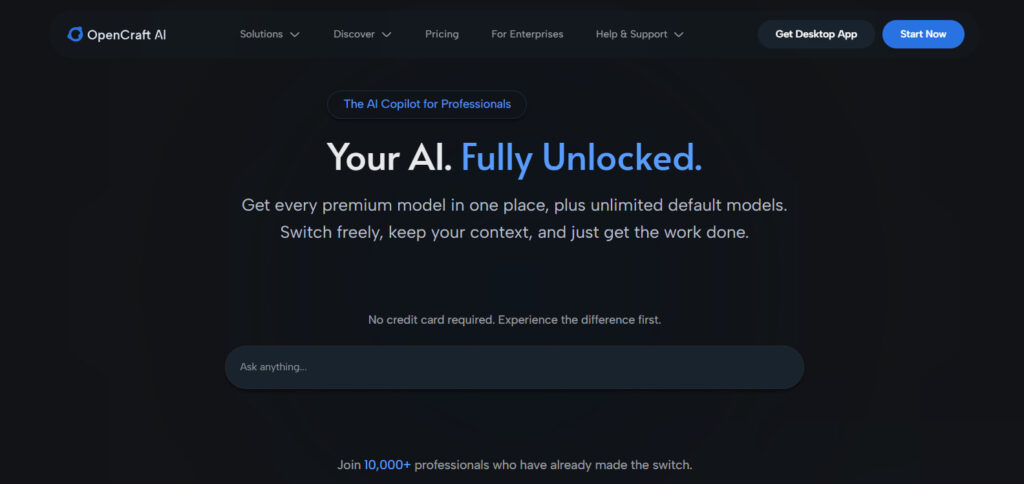
For that second group, Ocai is the answer we give clients. Open-weight models, no vendor lock-in, no rate caps, a sandbox, memory that compounds, and a publishing loop that pushes the asset out instead of making you copy it. Start with the free credits, run one real workflow, and compare what actually got finished.
FAQ: Best Claude Alternative Without Rate Limits
Is there any AI with truly no limits?
No. Every provider has compute costs and every honest page should say so. What exists is the difference between a tool that caps your usage by the clock and a tool that bills you for what you use. Ocai is the second kind.
What are Claude’s actual rate limits now?
Anthropic no longer publishes a fixed message count. Usage runs on rolling five-hour windows with weekly caps on paid plans. That is the official current position, and it is why planning capacity is hard.
Does Ocai use Claude’s models?
No. Ocai runs open-weight models: Ocai Swift, Ocai Core, Ocai Ultra, DeepSeek v4 Pro, and Kimi K3. The older claim on this page about “same Claude models” was wrong and has been removed.
Does Claude have memory now?
Yes. Persistent memory across conversations is available on every plan, including free. The old complaint about Claude forgetting context is outdated.
How much does Ocai actually cost?
Pay-as-you-go credits at published per-token rates. No commitment, no caps, credits never expire. A heavy user including creative work typically lands around $30 to $50 a month, though light users pay less.
Is Ocai safe for client and legal work?
The sandbox isolates what the agent runs, with the site’s stated guarantees that it cannot escape or delete your files, and that nothing is unrecoverable. The pricing page states there is zero training on your information.