ChatGPT Alternative for Writing? Here’s the Honest Shortlist
Every guide to “ChatGPT alternatives for writing” makes the same pitch: leave ChatGPT, switch to something narrower — a fiction tool, a brand-voice tool, a role-based helper.
Most writers and content teams do not actually want to leave ChatGPT behind. They want to fix what is missing. A single model, a rate limit that hits mid-session, and no way to bring in a second model for a second opinion — that is the real problem, and it has a different fix.
Quick answer: the best chatgpt alternative for writing right now
OpenCraft AI is the strongest pick for most content and marketing teams. It is not a replacement for ChatGPT so much as an upgrade path. One subscription, GPT included alongside Claude, Gemini, and other frontier models, no API keys required.
A writer keeps everything that already works about GPT-based drafting. They just stop hitting a wall mid-session. They can also pull in a second model to check tone or logic without opening a second browser tab.
The four other tools below solve real, narrower problems. None of them are bad choices. But most content teams reaching for a “ChatGPT alternative” are really reaching for more model access, not a smaller, more specialized chatbot.
Where ChatGPT actually falls short for content teams
ChatGPT is genuinely good at brainstorming, first drafts, and one-off writing tasks. The friction shows up once a team tries to run daily content production through it.
Long threads lose track of earlier context. A writer uploading months of brand guidelines or past posts often has to re-explain details that got dropped somewhere in the conversation.
Claude Pro, GPT Plus, and similar single-model subscriptions cap usage during busy periods. A content team mid-sprint on a launch week can hit that ceiling at the worst possible time.
And a single model means a single voice. Getting a second opinion on tone or logic means paying for, and switching to, an entirely separate subscription.
The access problem, in practice
Picture a five-person content team mid-launch. Someone drafts a landing page in ChatGPT, hits the session cap halfway through revisions, and has to wait out the reset window. Meanwhile another writer wants a second opinion from Claude on whether the copy sounds too stiff. That means a second login, a second subscription, and a copy-paste round trip just to compare two paragraphs.
None of that is a writing-quality problem. It is an access problem, and it is the exact gap a multi-model platform is built to close.
5 ChatGPT alternatives for writing, compared honestly
Each of these earns its spot on real teams’ toolchains for a specific reason. None of them are ranked to make one look worse than it actually is. The goal is matching the tool to the actual gap, not crowning a universal winner.
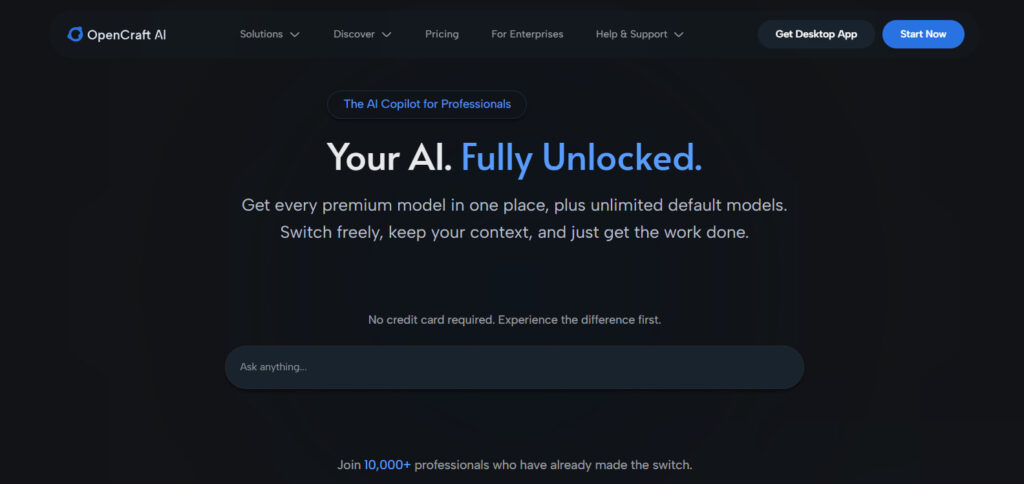
1. OpenCraft AI: best for teams who want more models, not a smaller chatbot
OpenCraft AI gives one login access to GPT, Claude, Gemini, and other leading models, with no API setup and no coding required. Model switching happens inside the same thread. That means a conversation keeps its full context, whether a writer is drafting in one model or getting a second opinion from another.
The plan structure runs four self-serve tiers, plus a custom Enterprise option:
- Lite: starts around $6 a month, the entry point for occasional or solo use.
- Essential: roughly $20 a month per user, adding a small number of custom experts, cloud storage, and a defined messaging allowance.
- Professional: roughly $25 a month per user, expanding to more custom experts, more storage, unlimited messaging, and database features.
- Team: built for multi-seat access, with shared workspace features.
- Enterprise: custom pricing, aimed at larger teams needing admin controls and security review.
A 14-day money-back guarantee covers new signups, and yearly billing runs at a discount versus paying monthly.
A writer can start a piece in GPT for speed. They can then hand the same thread to Claude for a tone pass, without copying anything between tools. Uploaded reference material, like brand guidelines or past posts, stays attached to the workspace instead of needing to be re-pasted every session.
Rate limits are the other thing that disappears. A long editing session or research sprint does not get cut off mid-flow the way a single-model plan can.
There is also a budget argument. A team paying separately for a GPT subscription and a Claude subscription is often paying two full monthly fees to get two models. Those two models could sit in one plan instead. Folding both into a single subscription tends to cost less than the two separate ones combined. It also adds a third or fourth model on top.
Who should skip it: Someone writing occasionally, with no interest in comparing model outputs, will not get much extra value here. Teams doing daily content work, or anyone who already pays for two separate model subscriptions, should take a serious look.
2. Claude Pro: the strongest single model for long-form writing
Claude Pro costs $20 a month and gives higher usage limits and priority access on Anthropic’s Claude models. Those models are widely regarded for long-form writing quality and a less mechanical prose style. A free tier exists with daily message limits for anyone who wants to try it first.
For heavier use, Anthropic offers two Max tiers above Pro, priced around $100 and $200 a month. Both give the same models as Pro, just with a much larger usage allowance rather than access to anything new.
Team plans exist for organizations, running roughly $25 to $30 a seat a month depending on tier. They add SSO, shared workspaces, and admin controls on top.
It is still a single-model subscription at every tier. A writer who wants to compare Claude’s output against GPT or Gemini needs a second, separate subscription to do it.
Who should skip it: Anyone who already wants multi-model access in one place is better served by a platform built around that. That’s a better fit than stacking two single-model subscriptions side by side.
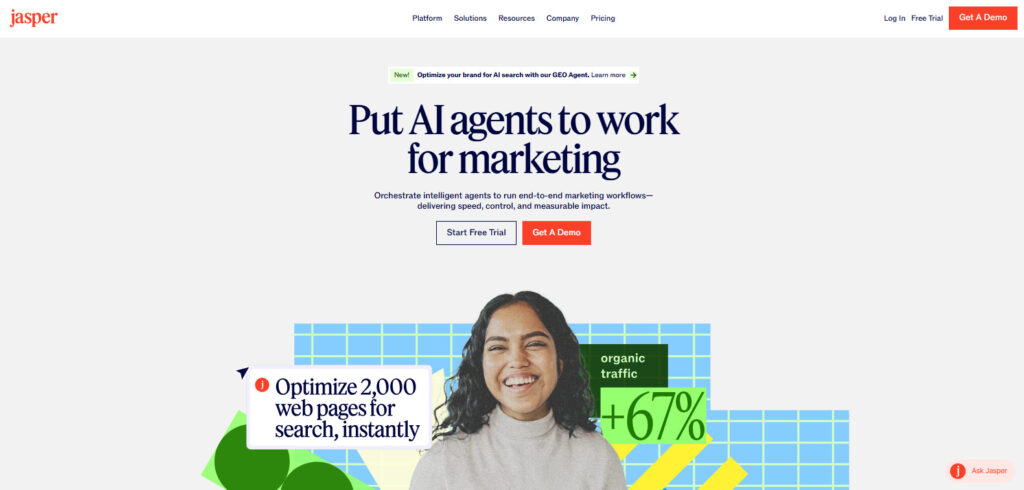
3. Jasper: the pick for brand-voice consistency at scale
$69 a month for one seat, dropping to $59 a month on annual billing. That is Jasper’s Pro plan, built around keeping a consistent brand voice across a large volume of marketing content.
The Pro plan includes a set number of saved brand voices, knowledge assets for reference material, and a handful of audience profiles. All of it is designed so different writers on a team produce content that reads like it came from one source.
Multi-seat access requires a custom-priced Business plan. Buyers report deployments ranging from several hundred to several thousand dollars a month. The range depends on team size, usage volume, and add-ons like single sign-on or a dedicated customer success manager.
An older, cheaper Creator tier still shows up on some third-party pricing pages, priced lower than Pro. Jasper’s own live pricing page currently leads with just Pro and Business. That lower tier should be confirmed directly with Jasper before budgeting around it.
Who should skip it: A team producing under 10 pieces a month rarely needs Jasper’s brand-voice machinery. A saved style prompt in a general-purpose model gets close enough for far less money.
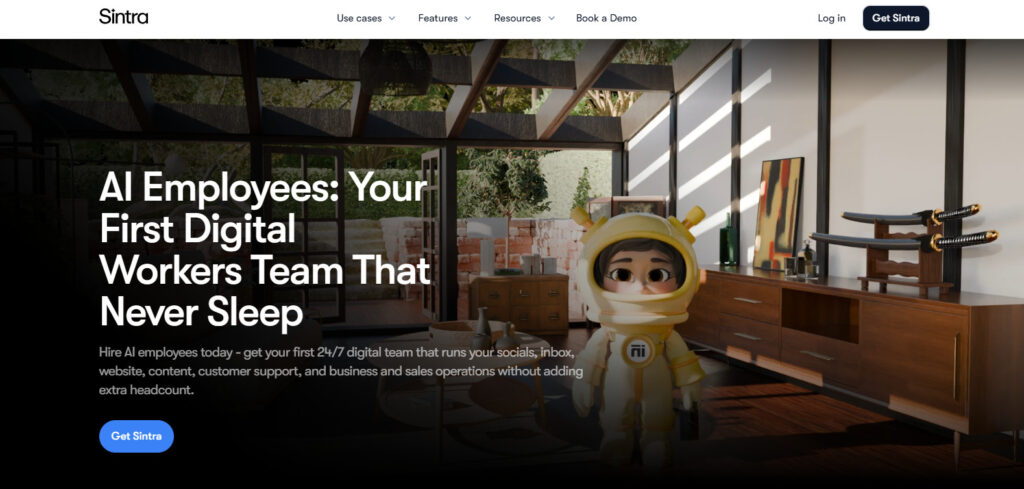
4. Sintra AI: role-based helpers instead of one general assistant
Sintra AI is a chat-based tool built around specialized AI helpers, each trained for a single role like content writing, email, or SEO cleanup. Those helpers are backed by a shared memory layer, called Brain AI, that keeps brand details consistent between sessions.
Sintra no longer sells access to a single helper. The current lineup is one plan, Sintra X, which unlocks all 12-plus helpers at once:
- Monthly billing: around $97 a month.
- Quarterly billing: discounted to roughly $24 a month.
- Annual billing: discounted further, to roughly $16 a month.
Every tier shares the same monthly credit pool. Paying more does not buy more usage, only a lower rate for committing longer upfront. Moderate to heavy use can run out of credits before the billing cycle resets, with no way to buy a top-up mid-month.
It does not support custom agents or automation across other tools, so it works best as a drafting aid rather than a workflow platform. A 14-day money-back guarantee applies to new signups.
Who should skip it: Teams that need to chain tasks across tools, or want custom automation, will hit Sintra’s ceiling quickly. It fits solo creators and small teams handling straightforward drafting work.
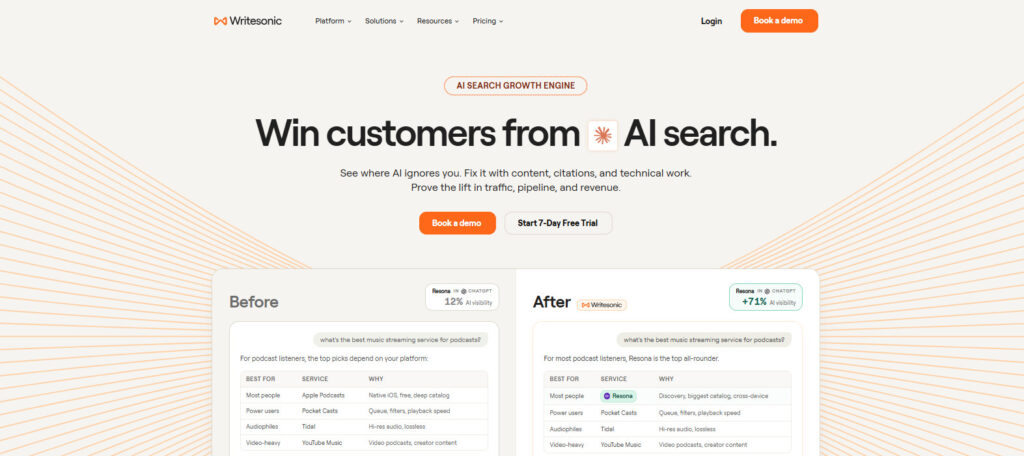
5. Writesonic: a writing tool that has quietly become something else
Writesonic used to be a straightforward AI writer. In 2026, its own homepage leads with AI search visibility tracking, not writing, and its plans reflect that shift:
- Starter: around $79 a month billed annually (roughly $99 month to month), tracking a limited number of daily prompts on ChatGPT only, with basic article and site-audit credits included.
- Basic: around $199 a month billed annually, adding Gemini and Google AI Overviews to the tracked platforms alongside ChatGPT.
- Growth: around $399 a month billed annually, expanding users, projects, article credits, and tracked prompt volume, with extra articles available as a paid add-on.
- Enterprise: custom pricing, covering all major AI platforms tracked, unlimited prompt tracking, and a dedicated account manager.
Content and article generation are still included. They now sit alongside visibility tracking as one part of a broader product, rather than the main offering.
Who should skip it: Anyone who picked Writesonic off an older “best AI writer” list should check the current pricing page first. The product being reviewed on many 2025-era roundups is not quite the product being sold today.
How to pick, based on what is actually missing
If the real complaint is “I lose my context in long threads” or “I hit my usage cap mid-session,” a multi-model platform like OpenCraft AI solves both at once.
A narrower complaint, like “my team’s content does not sound consistent,” is better matched by Jasper’s brand-voice tooling, which earns its higher price at real scale.
For a single very strong writing model and nothing else, Claude Pro or a similar single-model subscription is enough on its own.
Name the actual gap before picking a tool. Most of the frustration with ChatGPT turns out to be a model-access problem, not a writing-quality problem. Those are two different problems, and they have different fixes.
Budget matters too. A solo writer testing the waters can start under $20 a month with a single model. A small team ready to stop juggling logins usually lands between $6 and $30 a month per seat on a multi-model plan. That’s before adding any specialist tool on top. Brand-voice and role-based tools, at $70 to $100 a month, only start paying for themselves once volume or team size actually demands them.
FAQ: chatgpt alternative for writing
What is the best ChatGPT alternative for writing on a content team?
A multi-model platform like OpenCraft AI covers most team needs in one subscription. That includes GPT access alongside Claude and Gemini, without the context loss or rate limits of a single-model plan.
Is Claude better than ChatGPT for writing?
Claude is widely considered strong for long-form and nuanced writing, while GPT is often preferred for speed and broad general use. Many writers get better results comparing both on the same piece rather than picking one permanently.
Do I need to fully replace ChatGPT to fix its limitations?
No. Most of ChatGPT’s frustrations, like context loss and rate limits, come from using a single model in a single-purpose chat tool. Adding model access, rather than replacing the model entirely, solves that without losing what already works.
Is Writesonic still a good ChatGPT alternative for writing?
Writesonic has shifted its core product toward AI search visibility tracking rather than pure writing. Teams evaluating it in 2026 should check the current pricing and feature set rather than relying on older reviews.
How much does a ChatGPT alternative for writing typically cost?
Single-model subscriptions like Claude Pro start around $20 a month. Multi-model platforms start lower, around $6 a month on entry tiers. Specialized brand-voice or role-based tools run from $70 to $100 a month, depending on the plan.
Can I use ChatGPT and Claude together without paying for both separately?
Yes. Multi-model platforms bundle access to GPT, Claude, Gemini, and other models into a single subscription. That usually costs less than maintaining two or three separate model subscriptions side by side.