There is a problem that has been quietly consuming enterprise AI teams for the past eighteen months, and it has nothing to do with benchmarks or capabilities. It has to do with sovereignty. The work these teams do involves customers who are sensitive to nation-state politics. They cannot and do not use cloud API services for AI because the data must not leak. Ever. As a result, they use open models in closed environments. The problem is that these customers do not want Chinese models. "National security risk." But the only recent semi-capable open-weight models from the United States are aging architectures that have fallen behind the frontier. So they are in a bind: use an older, less capable model and slowly fall further and further behind the curve, or... what?
This is the open-weights paradox in its purest form, and it is reshaping the geopolitics of artificial intelligence in ways that the policy establishment has barely begun to grapple with. The United States, which spent a decade lecturing the world about the dangers of closed technology ecosystems, now produces the most closed AI models on the planet. China, which built the Great Firewall and pioneered digital authoritarianism, is now the world's leading exporter of open-weight foundation models. And India, long dismissed as a consumer rather than a producer of frontier technology, has quietly built its own sovereign AI stack with models specifically designed for the subcontinent's linguistic and infrastructural reality.
This is the story of how we got here, what it means for enterprises caught in the middle, and why the answer to "what do we do?" is far more nuanced than anyone in Washington, Beijing, or New Delhi is willing to admit.
The Capability Gap: A Tale of Three Release Strategies
To understand the bind that enterprises and government agencies now find themselves in, you have to look at the divergence in release strategies between US, Chinese, and Indian labs over the past two years. The contrast is stark enough that it almost seems deliberate.
OpenAI, which once promised to be "open" in more than name, has released only a handful of open-weight models since GPT-2, all of them deliberately constrained in capability and positioned as research tools rather than production systems. Anthropic has never released model weights and shows no intention of doing so. Google's Gemma series is open-weight but clearly positioned as a research offering, with the company's most capable systems locked behind APIs. Meta's Llama series remains the most capable American open-weight offering, but even its largest variants trail the frontier models from Chinese labs on key benchmarks. Inception Labs, a newer American entrant, has taken a different approach entirely: their Mercury series uses diffusion-based architectures rather than autoregressive transformers, offering a novel approach to text generation, but the weights remain closed and accessible only through API.
Now look at China. DeepSeek has released their R series, a family of reasoning-focused models with capabilities that rival or exceed GPT-class systems, with full weights available for download. Alibaba's Qwen series spans from compact models to massive mixture-of-experts architectures, all with open weights and permissive licensing. Zhipu AI's GLM series, Moonshot AI's Kimi family, 01.AI's Yi models, Baichuan's offerings, InternLM from Shanghai AI Laboratory. These are not research curiosities. They are production-grade systems, regularly updated, with active communities building on top of them.
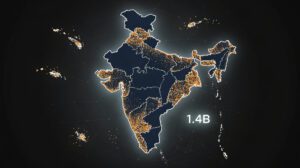
And then there is India. The IndiaAI Mission has catalyzed a sovereign AI ecosystem that most of the world has barely noticed. Sarvam AI, backed by the government's mandate, has released the Sarvam series, a family of Indic-language models designed from the ground up for the subcontinent's linguistic diversity. BharatGen has open-sourced their Param series, mixture-of-experts models optimised for Indian languages and low-resource deployment. These are not knockoffs of Western architectures fine-tuned on translated data. They are models trained on Indian data, for Indian use cases, with Indian languages as a first-class concern rather than an afterthought.
| Model Series | Origin | Architecture | Weights |
|---|---|---|---|
| DeepSeek R DeepSeek-AI, Hangzhou |
China | MoE Reasoning | Open |
| Qwen Alibaba Cloud |
China | Dense & MoE | Open |
| GLM Zhipu AI, Beijing |
China | Autoregressive | Open |
| Sarvam Sarvam AI, Bengaluru |
India | MoE Indic-Optimised | Open |
| Param BharatGen, India |
India | MoE Multilingual | Open |
| Llama Meta, Menlo Park |
USA | Dense & MoE | Open |
| GPT OpenAI, San Francisco |
USA | Autoregressive | Closed |
| Claude Anthropic, San Francisco |
USA | Constitutional AI | Closed |
| Gemini Google DeepMind |
USA/UK | Multimodal | Closed |
| Mercury Inception Labs, USA |
USA | Diffusion | Closed |
The pattern is unmistakable. American frontier labs have converged on a business model that depends on API lock-in: keep the weights closed, charge per token, and maintain exclusive control over the most capable systems. Chinese labs have converged on a strategy that looks almost like the opposite: release the weights, build ecosystems, and compete on deployment and services rather than model access alone. Indian labs have taken a third path: build sovereign models for a specific linguistic and cultural context, open-source them to maximise adoption, and create an ecosystem that serves the subcontinent's unique needs. There are business reasons for all three approaches. But the geopolitical consequences are only now becoming clear.
US frontier model series with open weights
Chinese frontier-class model series with open weights
Indian sovereign model series with open weights
The Sovereignty Paradox: When Open Means Vulnerable
For the systems integrators and enterprise AI teams building for security-conscious clients, the problem is not theoretical. The clients in question are the kind of organizations that have legitimate reasons to be paranoid about data sovereignty: defense contractors, intelligence-adjacent agencies, financial institutions with regulatory obligations, healthcare systems bound by HIPAA and its international equivalents. These are not customers who can simply sign up for an OpenAI enterprise account and trust that the data will be fine. The data must not leave the premises. Ever.
That requirement immediately rules out every closed model from every American lab. No GPT, no Claude, no Gemini, no Mercury. The only option is open weights deployed on premises, in air-gapped environments if necessary. And here is where the paradox crystallizes: the most capable open-weight models available today are Chinese. DeepSeek R, Qwen, GLM, these are the systems that match or exceed the capabilities of the closed American models that these organizations cannot use. But using them is, for many of these clients, politically impossible.
The objection is not purely irrational. There is a legitimate question about whether a model trained in China, on Chinese data, by Chinese engineers, could contain subtle biases, backdoors, or behaviors that would be difficult to detect. The model weights are open, yes, but a trillion floating-point numbers are not exactly easy to audit. The NSA managed to hide a backdoor in a cryptographic algorithm for years. The possibility that similar techniques could be applied to neural networks is not zero.
The model weights are open, but a trillion floating-point numbers are not exactly easy to audit. The NSA managed to hide a backdoor in a cryptographic algorithm for years. The possibility that similar techniques could be applied to neural networks is not zero.
Security Researcher
But here is the uncomfortable truth that the sovereignty debate circles around but never quite states directly: American models are not obviously safer. The same concerns about hidden behaviors, subtle biases, and undetectable backdoors apply to models trained by American companies. The difference is that with closed American models, you cannot even attempt to audit the weights because you do not have them. You are trusting OpenAI or Anthropic or Google or Inception Labs entirely on faith. With Chinese open-weight models, you at least have the option of inspection, even if the inspection is difficult. With Indian models, you have both openness and a geopolitical alignment that is neither American nor Chinese, a third pole that many organisations are only now beginning to consider.
This is the sovereignty paradox in its purest form. The organizations with the most stringent security requirements are being forced to choose between options that all violate their security assumptions: use a closed American model and trust a third party with sensitive data, use an open Chinese model and trust that the weights do not contain hidden behaviors, or use an Indian model that is open but optimised for a different linguistic and cultural context. There is no option that combines American origin, open weights, and frontier capability. That option simply does not exist.
The Third Pole: India's Sovereign AI Stack
If the United States and China represent the two dominant poles of the current AI landscape, India is quietly establishing itself as a third. The IndiaAI Mission, a government-backed initiative launched in 2024, has catalyzed an ecosystem of sovereign AI development that most Western observers have barely registered. But for organisations looking to escape the US-China binary, India's offerings are increasingly difficult to ignore.
Sarvam AI, the Bengaluru-based lab that has become the face of India's sovereign AI push, has released a family of models specifically designed for Indic languages. The Sarvam series is not a Western model fine-tuned on translated data. It is trained from scratch on Indian text, with Indian languages as a first-class concern. The architecture uses mixture-of-experts design to keep inference costs low, a deliberate choice for a market where compute is scarce and cost sensitivity is high. The weights are open, the licensing is permissive, and the geopolitical positioning is clear: this is Indian AI, built for Indian needs, but available to anyone who wants to use it.
BharatGen, another IndiaAI Mission beneficiary, has taken a similar approach with their Param series. These are multilingual mixture-of-experts models optimised for the subcontinent's linguistic diversity, covering languages that Western models handle poorly or not at all. Like Sarvam, the weights are open-sourced, the architecture is designed for frugal deployment, and the geopolitical positioning is explicitly non-aligned. India is not trying to compete with American or Chinese frontier models on general reasoning benchmarks. It is trying to build models that work for the billion-plus people who do not speak English as a first language.
For organisations caught between American closed models and Chinese open models, India offers a third path: open-weight models from a geopolitically non-aligned nation, designed for multilingual deployment, and optimised for cost-sensitive environments. The capability gap with frontier models remains, but for many enterprise use cases, the gap is smaller than the political cost of either American or Chinese alternatives.
The question for Western enterprises is whether Indian models are politically acceptable in a way that Chinese models are not. For some, the answer is yes. India is a democracy, a strategic partner of the United States, and a member of the Quad. Using an Indian model does not carry the same political baggage as using a Chinese one. But for others, the question is more complicated. Indian models are not trained for Western use cases. The linguistic optimisation that makes them valuable for the subcontinent makes them less valuable for, say, an American defense contractor or a European bank. The third pole exists, but it is not a universal solution.
The Infrastructure Problem: Models Do Not Live in Isolation
One of the more sophisticated points in the sovereignty debate is that models never operate in isolation. They are connected to databases, APIs, tool frameworks, and agentic systems that give them the ability to take actions in the real world. A model running on premises, with no external network access, is safe in the narrow sense that it cannot exfiltrate data. But the moment you connect it to anything, a retrieval system, a code execution environment, a tool-calling framework, you have created a potential attack surface.
This is where the security concerns about any model, regardless of origin, become more nuanced. The risk is not that the model itself will somehow transmit data to a foreign adversary. The risk is that the model, trained with certain biases or behaviors, could subtly influence the systems it is connected to in ways that are difficult to detect. A coding model that occasionally suggests a malicious package name. A reasoning model that steers strategic decisions in certain directions. An agentic system that takes actions that seem benign in isolation but compound into something harmful over time.
These are not hypothetical concerns. Researchers have demonstrated that it is possible to train "sleeper agent" behaviors into models that remain dormant until triggered by specific inputs. The weights are open and can be inspected, but the behaviors are encoded in the statistical patterns of a trillion parameters and are essentially impossible to detect through manual review. The only way to be confident that a model does not contain such behaviors is to train it yourself, from scratch, on data you control. And that is exactly what most organizations cannot afford to do.
The implication is that the origin of the model matters less than the infrastructure around it. A Chinese model deployed in a carefully sandboxed environment with rigorous output filtering may be safer than an American model deployed carelessly. An Indian model connected to sensitive systems without proper controls may be riskier than a closed American model accessed through a well-designed API. The geopolitics of model origin is only one variable in a much larger security equation.
The Path Not Taken: What American Open-Weight Advocates Wanted
It is worth remembering that this situation was not inevitable. When OpenAI was founded in 2015, its charter explicitly committed to providing "public goods" and sharing research "for the benefit of all." The "open" in OpenAI was not a branding exercise; it was a statement of values. The organization was founded as a counterweight to the closed, proprietary approach that Google and other tech giants were taking with their AI research. The idea was that AI was too important to be controlled by a handful of companies, and that open collaboration would accelerate progress while ensuring that the benefits were widely distributed.
That vision lasted approximately three years. By 2019, OpenAI had created a "capped profit" subsidiary and accepted $1 billion from Microsoft. By 2023, the organization had effectively abandoned any pretense of openness, with its most capable models available only through APIs that prevented direct access to the weights. The justification shifted from "AI is too important to be closed" to "AI is too dangerous to be open." The same organization that once promised to democratize access to artificial general intelligence was now arguing that the technology was so powerful that it had to be kept under tight control.
Meanwhile, Chinese labs were arriving at the opposite conclusion. DeepSeek, Alibaba, Zhipu, and others apparently decided that the best way to compete with American frontier models was not to match their closed approach but to invert it entirely. Release the weights. Build ecosystems. Let developers and enterprises deploy on their own terms. The strategy is not altruistic; it is a calculated bet that open weights will accelerate adoption, create lock-in at the ecosystem level rather than the model level, and position Chinese AI infrastructure as the default choice for the next generation of applications. It is working.
And India, seeing the gap between American closed models and Chinese open models, decided to build its own sovereign stack. Not to compete with either pole directly, but to serve a market that both were ignoring: the billion-plus people who do not speak English, who cannot afford frontier-model pricing, and who need AI that works in their linguistic and infrastructural reality. The result is an ecosystem that is neither American nor Chinese, neither closed nor fully frontier, but sovereign in a way that neither of the dominant players can claim to be.
The United States spent a decade lecturing the world about the virtues of open technology ecosystems. Now it produces the most closed AI models on the planet. China built the Great Firewall and pioneered digital authoritarianism. Now it is the world's leading exporter of open-weight foundation models. India, long dismissed as a technology consumer, has built a sovereign AI stack that is neither. The geopolitical irony is complete.
The Open Weights Paradox
The Way Forward: Escaping the Binary
For the organizations caught in this bind, there are no perfect solutions. But there are strategies that can mitigate the risk while preserving capability, and they all start from the same recognition: the problem is not the model. The problem is the infrastructure around the model.
The first strategy is to invest heavily in scaffolding and retrieval systems that compensate for weaker base models. A less capable model connected to a well-designed knowledge graph, a comprehensive RAG pipeline, and a carefully constructed workflow can outperform a more capable model operating in isolation. This is the approach that many enterprise AI teams are quietly adopting: use the best politically acceptable model you can find, and build infrastructure around it that maximizes its effectiveness for your specific use case. The model becomes a component rather than the system, and the system is what delivers value.
The second strategy is to develop custom benchmarks and compliance tests that evaluate models against the specific requirements of your domain. Rather than relying on generic capability benchmarks, create test suites that probe for the behaviors that matter most to your organization: accuracy on domain-specific tasks, absence of certain biases, reliability under edge-case conditions. This does not eliminate the risk of hidden behaviors, but it provides a data-driven basis for model selection that goes beyond political optics. A model that passes your tests is not guaranteed safe, but a model that fails your tests is guaranteed unsuitable.
The third strategy is to engage in the slow, expensive work of training your own models. This is not feasible for most organizations, but for the largest enterprises and government agencies, it may be the only path to true sovereignty. The infrastructure requirements are substantial: hundreds of millions of dollars in compute, access to training data at scale, and the technical expertise to execute a training run. But the organizations that make this investment will have something that no API provider can take away: a model that they own, understand, and control.
The fourth, and most practical for the majority of organizations, is to decouple the model from the application layer entirely. This is where the conversation shifts from geopolitics to architecture, and where a new category of tooling is beginning to emerge.
The Abstraction Layer: How OpenCraft AI Changes the Equation
What if the problem is not which model you choose, but that you are forced to choose at all? What if the solution to the open-weights paradox is not finding the right model, but building an infrastructure that makes the model choice irrelevant to your security posture?
This is the question that OpenCraft AI was built to answer. OpenCraft AI is a professional AI copilot that works with any model. Not some models, not most models, but any model you choose to deploy. Pick your model, air-gap it on-premises, and use it through an interface that is model-agnostic by design. The geopolitical risk of the model is contained by the architecture of the system. The capability of the model is enhanced by the scaffolding around it. The sovereignty of your data is guaranteed by the fact that nothing leaves your infrastructure.
The insight here is simple but powerful: the model is not the product. The model is a component, and components can be swapped. What matters is the system that integrates the model, the tools, the data, and the workflows into something that delivers value. OpenCraft AI provides that system. You provide the model. The combination gives you capability without compromise, sovereignty without sacrifice.
OpenCraft AI de-risks model development and geopolitical risk by decoupling the application layer from the model layer. Deploy any model, on any infrastructure, with full control over your data and your destiny. The model you choose today does not lock you into the model you must use tomorrow. Swap models as the landscape evolves. Keep your workflows, your data, your integrations. Change only the component that needs changing.
Consider what this means in practice. An organization that needs to serve both English and Indic languages can deploy Sarvam for Indian users and Llama for English users, all through the same OpenCraft AI interface. An organization that is prohibited from using Chinese models can deploy American or Indian alternatives without rebuilding their application layer. An organization that wants to evaluate a new model can swap it in, run tests, and swap it out if it does not meet their requirements, all without touching the rest of their infrastructure.
The model becomes a plug-in. The system becomes the asset. And the geopolitical risk that seemed so intractable when you were forced to choose a single model becomes manageable when you can choose any model, or multiple models, or change models as the situation evolves.
This is not a panacea. The underlying concerns about model behavior, hidden biases, and sleeper agents do not disappear. But they become tractable. You can test a model before you deploy it. You can monitor its behavior in production. You can swap it out if something seems wrong. The model is no longer a black box that you must trust or reject. It is a component that you can evaluate, control, and replace.
The open-weights paradox is real. American labs have closed their models. Chinese labs have opened theirs. Indian labs have built a third path. For organizations that need sovereign AI, none of these options is perfect. But the imperfection of each option becomes less paralyzing when you have an infrastructure that lets you choose, evaluate, and change. OpenCraft AI provides that infrastructure. The rest is up to you.
The United States has a sovereignty problem of its own making. China has an openness strategy that serves its interests. India has a sovereign stack that serves its people. But enterprises do not need to pick a winner.
The open-weights paradox is not going to resolve itself. As Chinese labs continue to release frontier-class models with full weights, as American labs continue to lock their best systems behind APIs, and as Indian labs continue to build for the subcontinent's unique needs, the capability gap between politically acceptable and technically optimal options will persist. The question is not which model to choose. The question is whether you have an infrastructure that lets you make that choice on your own terms. OpenCraft AI provides that infrastructure. Pick your model. Air-gap it on-prem. Use it through a professional copilot that works with any model. The geopolitics of AI is not your problem to solve. Your problem is building systems that work regardless of the geopolitics. That problem has a solution.