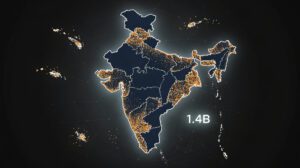
From ByteDance's market-dominating doubao to a quant trading firm's side project that reshaped global conversations about AI efficiency, the story of Chinese large language models is unlike anything happening in Silicon Valley. It is messier, faster, stranger, and arguably more innovative, precisely because it has to be. Over the past three years, China has quietly constructed a fiercely competitive AI landscape that most of the world has been missing.
The companies at the top of China's AI hierarchy are titans with deep balance sheets, massive infrastructure, and distribution networks that dominate. Think of them as China's answer to Google, Microsoft, and Amazon. Each has poured billions into AI, fighting not just for market share but for relevance in an era where the technology their empires are built on is being rebuilt from scratch.
ByteDance domestic compute deployment 2026
AI "Small Tigers" competing for survival
Tokens served by Step 3.5 Flash in 7 days
Part One
The Big Boys: Giants With Everything to Lose
ByteDance is the closest thing China has to OpenAI. Their doubao model dominates domestic usage, and their Seedance text-to-video product has become a mainstream consumer phenomenon. They plan to deploy roughly fifty-five billion dollars in domestic compute in 2026 alone. Alibaba has become the open-weight king. The Qwen family of models is the crown jewel, best-in-class at smaller sizes, and a strategic tool to win enterprise trust across Southeast Asia where compliance-sensitive buyers need to run models locally first.
Tencent is quietly building toward what may be its natural home: AI for game development. With massive stakes in studios worldwide, Hunyuan 3D and HY-Motion target the trillion-dollar games industry in ways other labs simply are not. Baidu, the original Chinese AI company, is now somewhat outpaced in the LLM race. Ernie is proprietary but not widely beloved. Baidu's real edge may be in autonomous driving, a longer game, but one with enormous stakes.
Then there are the surprises. Xiaomi, a phone company that has no business being this good at AI. MiMo V2 Pro has topped usage charts on OpenRouter, and one commenter described it as "the closest thing to Claude at home, except way less inhibited." Coming from a hardware company, it is extraordinary. Meituan, the food delivery giant, has quietly released LongCat, a 562 billion parameter model with dynamic mixture-of-experts activation. What is clever: inference cost scales with task complexity rather than sitting fixed, making it genuinely interesting for production deployment at scale.
The Big Boys share a common strategic logic: AI is not a product; it is the new operating system for everything they already do. ByteDance's internal teams run on doubao. Alibaba's cloud customers are slowly migrating to Qwen. Tencent's studios are early-testing Hunyuan in game pipelines. The model is the moat, built to defend existing businesses, not to build new ones.
| Company | Flagship Model | Strategic Focus |
|---|---|---|
| ByteDance Market Leader |
doubao, Seedance | Consumer dominance, $55B compute deployment |
| Alibaba Open Weight King |
Qwen family | Enterprise trust, Southeast Asia expansion |
| Tencent Specialist |
Hunyuan 3D, HY-Motion | Game development, studio integration |
| Baidu Infrastructure |
Ernie | Autonomous driving, enterprise search |
| Xiaomi Surprise Entrant |
MiMo V2 Pro | Consumer devices, on-device AI |
| Meituan Scale Experiment |
LongCat (562B MoE) | Dynamic inference cost scaling |
Part Two
The Six Small Tigers: Speed, Necessity, and the Art of Survival
If the Big Boys are the established order, China's "Six AI Small Tigers" are the insurgents: Zhipu, MiniMax, Moonshot (Kimi), Stepfun, Baichuan, and 01 AI. They are smaller, faster, and hungrier, each racing to find the niche that keeps them alive long enough to matter.
Their business model is elegantly simple and existentially precarious: release a large open-weight model to earn recognition from the developer community, then monetize through cheap, high-volume inference. The open-weight release is both a marketing move and a bet that community adoption will generate enough downstream momentum to sustain the operation. Several of them, MiniMax and Zhipu among them, have already IPO'd in Hong Kong, turning community attention into capital.
But "simple" does not mean easy. These companies are burning cash with no guaranteed ceiling on costs and no certain floor on revenue. The question everyone is asking, and nobody can answer, is whether any of them can survive long enough to become profitable before ByteDance or Alibaba simply out-spends them into irrelevance.
| Model | Tokens Served (7 days) | Technical Innovation |
|---|---|---|
| Step 3.5 Flash Stepfun |
1.61 trillion | Frontier model with released base weights |
| MiniMax M2.5 MiniMax |
1.39 trillion | 229B params, only 10B active at inference |
| GLM Series Zhipu AI |
High volume | Autoregressive with long context |
| Kimi Moonshot AI |
High volume | Long-context optimization |
What keeps the tigers interesting is not just their survival instinct but their technical creativity. MiniMax's architecture activates only ten billion parameters at inference time from a 229 billion parameter model, dramatically lowering the cost per token and letting them undercut competitors while staying competitive on quality. Stepfun has done something genuinely rare: released the base weights of a frontier model, giving fine-tuners and researchers access that most labs, East or West, refuse to provide.
The cynics say the tigers will eventually be absorbed or starved out. The optimists point to a different history: in China's electric-vehicle industry, a similar wave of "small tigers" produced BYD, NIO, and a generation of engineers whose talent has since raised the floor for every company in the sector. Even if most of the AI tigers do not survive, the talent they have trained may be China's most durable competitive advantage.
Part Three
The Wildcard: DeepSeek and the Alchemy of Constraint
Then there is DeepSeek, a side project at High-Flyer Capital Management, an algorithmic trading firm in Hangzhou. Not a tech giant. Not a government lab. A quant fund. The people building it were steeped in reinforcement learning from their trading work; optimizing models under tight resource constraints was not a corporate mandate but a professional reflex. When they turned those instincts toward language models, the results were remarkable.
Multi-Head Latent Attention (MLA) is a new attention mechanism that dramatically reduces the memory footprint of key-value caching, an architectural innovation now replicated across the industry. Group Relative Policy Optimization (GRPO) is a reinforcement-learning method born from trading research, applied to model alignment. More efficient than standard RLHF approaches and now widely cited in post-training literature globally. DeepSeek Sparse Attention (DSA) is a sparse attention variant that allows models to handle longer contexts without proportional compute costs, critical for production applications in enterprise settings.
When DeepSeek's results became public, it triggered a genuine re-evaluation across Western labs of whether the compute-scaling orthodoxy was the only path forward. The model had achieved frontier performance at a fraction of the expected cost.
The deeper truth about DeepSeek is not just about clever engineering, it is about what constraints produce. China's AI companies operate under significant limitations on access to cutting-edge chips. For most companies, that would be a ceiling. For DeepSeek, it appears to have been a forcing function.
The Dragon Awakens
The irony is profound: the sanctions intended to slow China's AI development may have, in some ways, accelerated the kind of research that matters most. When you cannot simply throw more compute at a problem, you have to find better algorithms. When better algorithms are the only viable path, you develop researchers who are unusually good at finding them.
Part Four
The Open-Weight Advantage: Why China Ships What Others Hoard
One of the most striking features of China's AI landscape, viewed from the outside, is how much gets open-sourced. While Western labs have increasingly retreated behind closed weights and API-only access, Chinese companies, big and small, have consistently made their models available for download, fine-tuning, and local deployment.
This is not altruism. It is strategy, and it works on multiple levels simultaneously.
For companies like Alibaba with Qwen, open weights serve as a globally distributed marketing machine. Every developer who fine-tunes Qwen, every startup that builds on it, every researcher who cites it, each one extends Alibaba's reach into markets where their proprietary cloud product might otherwise never land. Enterprise customers in Southeast Asia who need to prove to regulators that they can run AI locally find in Qwen exactly the on-ramp they need before committing to Alibaba Cloud contracts.
For the Small Tigers, open weights are an existential play. Without the brand recognition of OpenAI or the deep pockets of Google, they need a shortcut to credibility. A model that ranks well on public benchmarks, that developers can actually run and test, earns a kind of trust that marketing cannot buy.
| Strategy | Western Labs | Chinese Labs |
|---|---|---|
| Weight Release Access model |
Closed, API-only for frontier models | Open weights, permissive licensing |
| Revenue Model Monetization |
Per-token API pricing, enterprise contracts | Inference services, ecosystem lock-in |
| Developer Relations Community |
Limited access, waitlists, partnerships | Full access, fine-tuning encouraged |
| Enterprise Path Adoption |
Cloud deployment, managed services | On-premises, local deployment, sovereignty |
And for the entire ecosystem, the cumulative effect of so many open-weight models is a remarkable accelerant on research. When MiniMax, Stepfun, and DeepSeek all release their weights, the entire global research community can study them, find their weaknesses, propose improvements, and publish. The pace of iteration is higher than any single closed lab can match.
Part Five
The Anomalies: Stories That Should Not Be Possible
None of China's AI moment is complete without a few stories that simply sound implausible until you look at the data.
Xiaomi's anonymous debut. When a model calling itself "Hunter Alpha" appeared on OpenRouter in early 2026 and promptly topped the leaderboard, the community assumed it must be from one of the major labs. It was not. It was Xiaomi, a company best known for affordable smartphones and smart-home appliances. The reveal dropped on Bilibili and the Chinese tech community "was losing it," according to one observer who follows Chinese-language tech closely. A phone company beating dedicated AI labs was, in their words, "not in anyone's prediction." MiMo V2 Pro has remained at the top of usage charts ever since.
The quant firm that rewrote the rules. High-Flyer Capital's DeepSeek did not just produce a competitive model, it produced architectural innovations that labs with ten times the resources had not found. GRPO, MLA, and DSA are now referenced in research papers from labs worldwide. The techniques did not come from a university or a hyperscaler. They came from people who spent their careers optimizing trading strategies and applied those instincts to a different kind of optimization problem entirely.
The food delivery giant's frontier model. Meituan, the company that delivers your lunch, built LongCat, a 562 billion parameter model with dynamic MoE activation. Not because they needed a frontier model for food delivery, but because the compute and data infrastructure they had built at scale to optimize delivery logistics turned out to be surprisingly applicable to model training. Constraints, again, creating unexpected competence.
While the West debates AI safety and moats, China is shipping. The open-weight strategy is not generosity, it is the most rational competitive move available to companies that cannot yet out-spend their rivals.
The Dragon Awakens
Part Six
The Question the Industry Will Not Ask
There is a question lurking beneath all of this that the mainstream AI conversation is remarkably reluctant to engage with directly: Is the Western model of AI development, closed weights, enormous fundraises, safety-first communication, and API-only access, actually winning?
On token volume, China is competitive. On architectural innovation, they are arguably ahead. On open-weight availability, they are dramatically more generous. On iteration speed, they are faster. And on cost efficiency, the thing that will ultimately determine who can sustain this race, they have been forced into excellence by the very sanctions meant to hold them back.
None of this means China has "won" the AI race. The most powerful frontier models still come from Western labs. The safety research, interpretability work, and alignment frameworks being developed at Anthropic, DeepMind, and academic institutions represent a body of knowledge that cannot be acquired purely through competition. And the compute deficit created by export controls is real, it constrains what Chinese labs can train even if it sharpens how they train it.
But the framing of "the AI race" as a two-horse contest between OpenAI and Google has always been parochial. The race has at least a dozen serious competitors. Several of the most interesting ones do not speak English as their first language. And many of the most important architectural ideas of the past two years arrived not from Palo Alto, but from Hangzhou, Shanghai, and Beijing.
Chinese frontier-class open-weight model series
US frontier model series with open weights
Cost efficiency advantage from constraint-driven innovation
Part Seven
The Access Problem: Why Chinese Models Remain Out of Reach
For all their technical merit, Chinese AI models present a practical problem for Western developers and enterprises. The access friction is real. Payment systems do not connect. Language barriers persist. Documentation is often in Mandarin. API endpoints require Chinese phone numbers or WeChat accounts. Enterprise contracts navigate unfamiliar legal frameworks. The result is that most Western organizations, even those technically sophisticated enough to evaluate the models on merit, simply cannot use them in production.
This is not an accident. The friction serves both Chinese and American interests in different ways. Chinese labs can claim global openness while their domestic market remains protected. American policymakers can claim national security while their domestic labs maintain pricing power. Everyone wins except the developers and enterprises caught in the middle, forced to choose between politically acceptable but closed American models or technically superior but practically inaccessible Chinese ones.
The irony is that the open-weight strategy, which should make Chinese models universally accessible, instead creates a new kind of gatekeeping. The weights are free, but the infrastructure to use them effectively is not. Fine-tuning requires compute. Deployment requires expertise. Integration requires documentation and support. The model is open, but the ecosystem around it is not.
Chinese labs release open weights but create friction through payment systems, language barriers, and documentation gaps. American labs keep weights closed but provide seamless API access. The result: developers can download Chinese models but struggle to use them in production, while they can use American models in production but cannot inspect or modify them. Neither option is truly open.
Part Eight
The Bridge: How OpenCraft AI Changes the Equation
What if the problem is not which model you choose, but that you are forced to navigate entirely different ecosystems to access them? What if the solution to the China-West AI divide is not political reconciliation but technical abstraction?
This is the question that OpenCraft AI was built to answer. OpenCraft AI aggregates the best models from both Western and Chinese labs into a single, unified interface. The platform removes the friction of juggling multiple API keys, navigating Chinese payment systems, or dealing with language barriers. Users can compare models side-by-side, route requests intelligently to the most cost-effective model, and access open-weight Chinese models for local deployment, all in one place.
The insight here is simple but powerful: the model is not the product. The model is a component, and components should be swappable. What matters is the system that integrates the model, the tools, the data, and the workflows into something that delivers value. OpenCraft AI provides that system. You choose the model. The platform handles the rest.
OpenCraft AI de-risks model selection by providing unified access to models from any origin. Deploy DeepSeek for cost efficiency, Qwen for multilingual tasks, Llama for Western compliance, or Claude for reasoning-heavy workloads. All through the same interface, with the same authentication, the same billing, the same documentation. The geopolitical complexity of model selection becomes someone else's problem. You focus on building applications.
Consider what this means in practice. A developer building a customer service bot can test DeepSeek, Qwen, and GPT side-by-side, evaluating which produces the best responses for their specific use case, without setting up three different accounts or navigating three different documentation sites. An enterprise with data sovereignty requirements can deploy Qwen on-premises through OpenCraft AI's infrastructure, maintaining control over their data while accessing Chinese model capabilities. A startup can optimize costs by routing simple queries to cheaper Chinese models and complex queries to more capable Western ones, all through a single API.
The model becomes a plug-in. The platform becomes the asset. And the geopolitical divide that seemed so intractable when you were forced to choose between ecosystems becomes manageable when you can access any model through a unified abstraction layer.
| Capability | Direct Access | OpenCraft AI |
|---|---|---|
| Model Selection Choice |
Separate accounts per lab, different APIs | Unified interface, any model |
| Chinese Models Access |
Payment friction, language barriers | Seamless access, English documentation |
| Cost Optimization Efficiency |
Manual routing, separate billing | Intelligent routing, unified billing |
| On-Premises Sovereignty |
Download weights, build infrastructure | Deploy any model, managed infrastructure |
| Comparison Evaluation |
Manual testing across platforms | Side-by-side comparison, same interface |
Part Nine
Why Chinese Models Are Worth the Effort
Chinese AI models often outperform their Western counterparts in several key areas, and understanding these advantages is essential for any organization making infrastructure decisions.
Cost efficiency. Constraints on chip access have driven Chinese teams to develop leaner, more efficient architectures. MLA, DSA, and sparse activation techniques deliver comparable quality at a fraction of the inference cost. For high-volume applications, the cost difference compounds rapidly. A model that costs one-tenth as much to run while delivering ninety percent of the capability changes the economics of what becomes viable.
Open weights. Unlike many Western labs, Chinese companies release full model weights, enabling fine-tuning, local deployment, and deeper research. This is critical for enterprises with data-privacy needs or researchers pushing the boundaries. The ability to inspect, modify, and optimize a model for specific use cases is not a luxury. It is a requirement for many production deployments.
Multilingual prowess. Built for a domestic market that demands strong Chinese-language performance, these models also excel in English, Japanese, Korean, and other Asian languages. For organizations serving global or Asian markets, Chinese models often outperform similarly sized Western models on multilingual tasks. The training data includes languages that Western models treat as afterthoughts.
Rapid iteration. The competitive pressure in China drives frequent updates and architectural innovations. Models improve faster. New capabilities ship sooner. The ecosystem moves at a pace that Western labs, with their longer release cycles and safety review processes, struggle to match. For developers building on the cutting edge, velocity matters.
A model that costs one-tenth as much to run while delivering ninety percent of the capability changes the economics of what becomes viable. The cost difference compounds rapidly. For high-volume applications, Chinese models are not just competitive. They are transformative.
The Dragon Awakens
The dragon has not just awoken. It has been training while the rest of the world was watching something else.
The story of Chinese AI is not a story about geopolitics, though geopolitics is everywhere in it. It is a story about what happens when brilliant engineers face impossible constraints, brutal competition, and the genuine need to build, not for an IPO, not for a safety announcement, but because the technology actually matters to the market they serve every day. Some of the tigers will die. Some of the big boys will stumble. But the talent, the techniques, and the architectural decisions being made right now in China will shape AI for the next decade, whether the rest of the world notices or not.
OpenCraft AI makes the dragon accessible. By aggregating models from Western and Chinese labs into a single interface, the platform removes the friction that has kept Chinese models out of reach for most Western developers. Compare DeepSeek against Claude. Route queries to Qwen for multilingual tasks. Deploy on-premises with full sovereignty. The geopolitical complexity becomes infrastructure. The infrastructure becomes invisible. You focus on building applications that work.