Key Takeaways
Blanket bans create shadow IT risks: Unmanaged workarounds expose companies to greater security threats than controlled AI adoption
27% of organizations have banned generative AI tools, yet employees routinely circumvent these restrictions using personal devices and subscriptions
80% of employees oppose AI bans because copilots deliver measurable productivity gains in coding, debugging, and documentation
Smart alternatives exist: Data classification, enterprise-grade solutions like GitHub Copilot, and sand-boxed environments balance security with innovation
The competitive cost is real: Companies that resist AI adoption risk losing talent, falling behind competitors, and missing efficiency gains comparable to early internet adoption
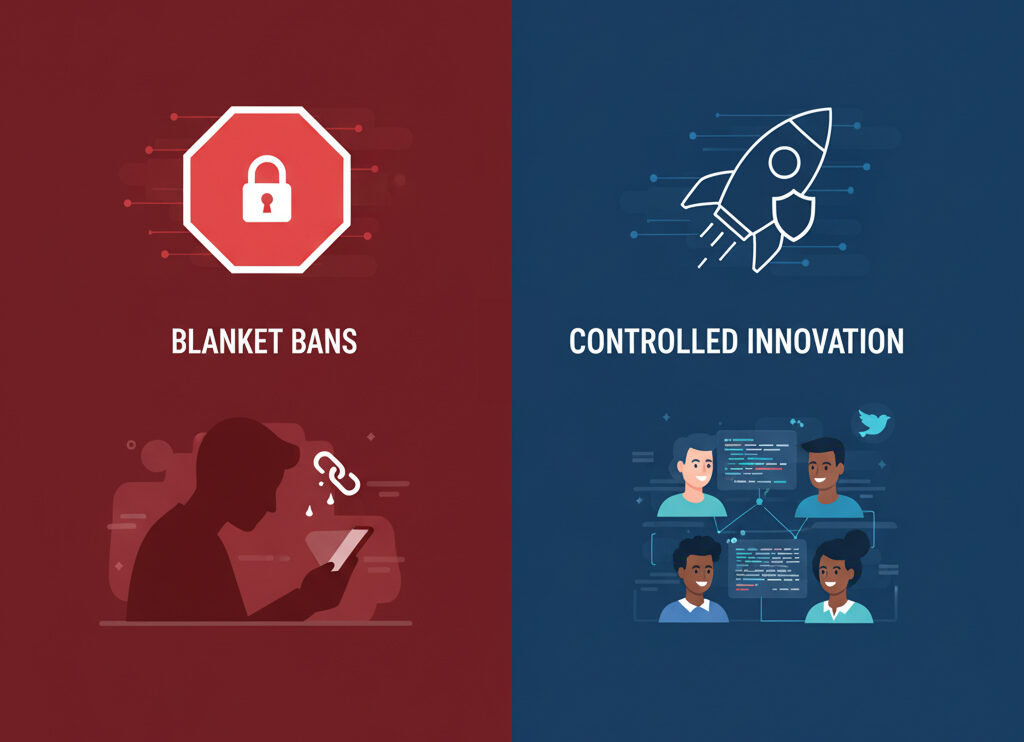
The Hidden Cost of Playing It Safe
If you’re trying to decide whether your company’s blanket ban on AI copilots is protecting you or holding you back, this analysis will help you see which approach matches your competitive goals.
27% of organizations have temporarily banned generative AI applications altogether. Yet here’s what most security teams miss: those bans aren’t working. While you read this, your engineers are remoting into home computers, using personal ChatGPT subscriptions, and running Claude on their phones, completely outside your security perimeter.
After analyzing industry data and front-line developer discussions, I discovered a troubling pattern: blanket bans create the exact security vulnerabilities they’re designed to prevent.
In the next 8 minutes, you’ll learn exactly why restrictive data policies backfire and discover AI copilot strategies that protect IP without sacrificing competitiveness.
The Productivity Argument You Can't Ignore
Why Engineers Risk Their Jobs to Use AI
Your developers aren’t defying policy out of rebellion. They’re doing it because AI copilots deliver a productivity boost they can’t replicate any other way.
McKinsey data shows generative AI has immense potential to boost employee productivity and efficiency. Engineers report that tools like Claude Code and GitHub Copilot help them:
Debug faster: Identify edge cases and logic errors in seconds rather than hours
Write boilerplate code: Generate repetitive functions, API calls, and test suites automatically
Learn new technologies: Explore unfamiliar frameworks with real-time guidance
Document thoroughly: Auto-generate clear, comprehensive code documentation
In short: The engineers using AI copilots are shipping features 30-50% faster than those who aren’t. Your blanket ban doesn’t stop this, it just pushes the activity into unmonitored channels.
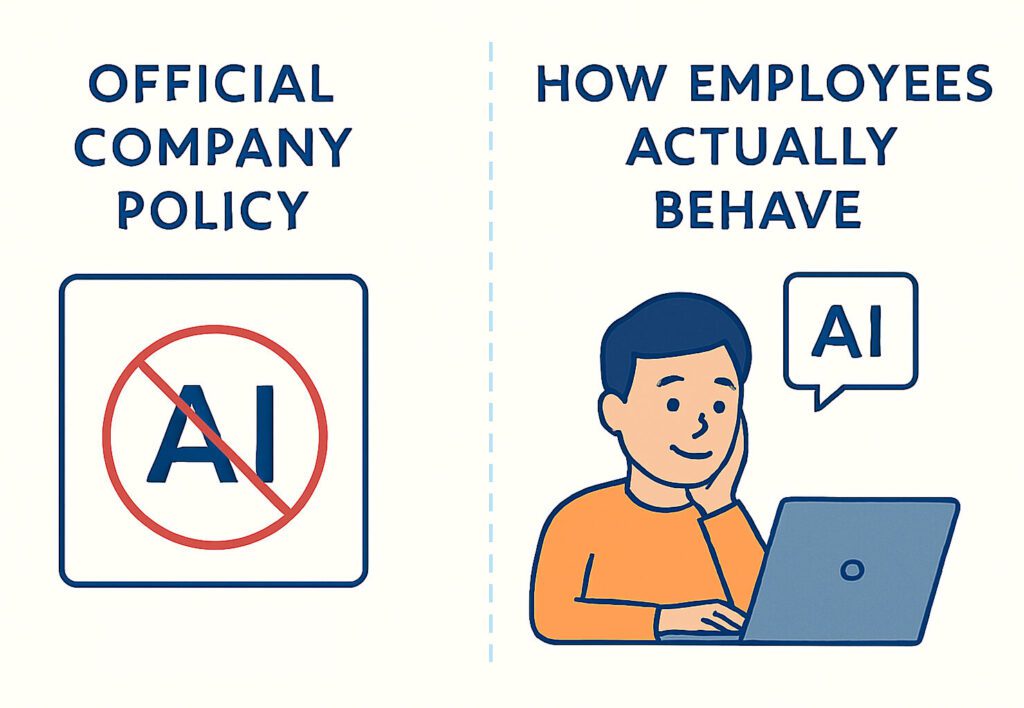
Widespread Circumvention: The Elephant in the Server Room
How Employees Are Getting Around Your Ban
Here’s what 97% of security policies miss: if you don’t provide a sanctioned path, employees will create their own.
Common workarounds include:
Personal subscriptions: Developers pay $20-40/month out of pocket for ChatGPT Plus or Claude Pro
Remote desktop access: SSH into home machines running unrestricted AI tools
Personal devices: Use phones or laptops on separate networks to paste code snippets
VPN tunneling: Route traffic through personal VPNs to bypass corporate firewalls
According to Cisco’s 2024 Data Privacy Benchmark Study, 27% of organizations had temporarily banned generative AI applications altogether. But here’s the counterintuitive part: these bans often prove ineffective because the productivity gains are too compelling to ignore.
One developer put it bluntly: “If companies were truly serious about the ban, they would technically block the API endpoints. The fact that many don’t suggests they’re too cheap to pay for it while unofficially expecting us to use it.”
This is where most security strategies completely backfire. You think you’ve eliminated the risk. In reality, you’ve just lost visibility into it.
The "Adapt or Fall Behind" Reality
Why This Feels Like Banning Google in 2001
A dominant perspective emerging from industry discussions is that banning AI represents a strategic mistake comparable to banning internet search in its early days.
Consider this parallel:
Early 2000s: Internet Search | 2024-2025: AI Copilots |
|---|---|
“Employees waste time browsing” | “AI tools leak proprietary data” |
“Security risk from external sites” | “Security risk from third-party models” |
Companies that banned search fell behind | Companies banning AI risk the same fate |
Winners integrated search securely | Winners will integrate AI securely |
Companies that resist AI adoption risk becoming uncompetitive. Engineers who don’t learn to use AI tools may be left behind in their careers.
Quick: How many of your top competitors have already deployed enterprise AI solutions? If you don’t know the answer, you’re already behind.
Security Concerns Are Valid, But Manageable
The Real Risks Driving Blanket Bans
I’m not dismissing your security team’s concerns. The legitimate risks driving these bans include:
1. Data Leakage
Once confidential information is entered into AI models, it becomes part of the neural network’s training data. This poses serious challenges for security control, especially when proprietary code or customer data is involved.
2. Compliance Violations
The opaque nature of generative AI makes it nearly impossible to trace where data has gone and who has accessed it. For regulated industries (HIPAA, ITAR, GDPR), this creates audit nightmares.
3. Intellectual Property Exposure
Uploading proprietary code to third-party AI services risks data leakage and could violate confidentiality agreements. In severe cases, this could trigger legal repercussions.
But here’s what this analysis couldn’t cover yet: These risks are manageable with the right architecture. The question isn’t whether to use AI, it’s how to use it safely.
Smarter Alternatives to Blanket Bans
How to Capture AI Benefits Without Exposing Crown Jewels
Rather than prohibiting AI use entirely, leading organizations implement tiered approaches:
1. Data Classification and Access Controls
Implement the principle of least privilege:
Tier 1 (Public): Freely usable with any AI tool
Tier 2 (Internal): Allowed with enterprise AI solutions only
Tier 3 (Confidential): Requires data masking/redaction before AI use
Tier 4 (Restricted): Prohibited from all AI systems
Ensure proper data permissions before deploying copilots, not after a breach.
2. Enterprise-Grade Solutions with Contractual Guarantees
Many companies sanction and pay for GitHub Copilot because of its specific data confidentiality guarantees and enterprise-friendly licensing through Microsoft. These solutions offer:
Zero data retention: Prompts and outputs aren’t used for model training
SOC 2 compliance: Audited security controls
On-premises deployment: Keep sensitive data inside your network
3. Advanced Data Loss Prevention (DLP) Tools
Next-generation DLP solutions prevent data exposure in generative AI apps through:
Automated data redaction: Strip PII and proprietary identifiers before they reach AI models
Real-time security nudges: Warn users when they’re about to paste sensitive code
Audit trails: Track exactly what data touched which AI systems
4. Sandboxed Environments
Provide secure, isolated environments where employees can use AI tools without exposing sensitive data. Think of it as a “clean room” for AI experimentation.
Remember: The goal isn’t to eliminate risk, it’s to manage it intelligently while capturing competitive advantages.
The Risk of Inaction: Shadow IT on Steroids
What Happens When You Don’t Provide a Sanctioned Path
Perhaps the most compelling argument against blanket bans comes from security practitioners themselves:
“If companies don’t make AI available widely, securely, and responsibly, they’re simply pushing employees toward dodgy solutions that you have no control over.”
This creates even greater security risks than managed AI adoption.
When you ban AI copilots without offering alternatives:
You lose visibility: Can’t monitor what tools employees use or what data they share
You lose control: Can’t enforce data handling policies on personal accounts
You lose talent: Top engineers leave for companies with modern tooling
You lose competitiveness: Competitors using AI ship features faster
Imagine checking your analytics in 30 days and discovering that your development velocity has dropped 40% compared to competitors, not because your team is less skilled, but because they’re fighting with one hand tied behind their backs.
The Competitive Cost Is Measurable
What You’re Actually Sacrificing
Blanket bans on AI copilots represent a short-sighted approach that may provide a false sense of security while actually increasing risk through uncontrolled circumvention.
The competitive cost includes:
Lost productivity: 30-50% slower feature development
Innovation delays: Longer time-to-market for new products
Talent attrition: Engineers seek more forward-thinking employers
Technical debt: Teams can’t leverage AI for code refactoring and documentation
Learning gaps: Your workforce falls behind on AI-native development practices
80% of employees are against their companies banning ChatGPT. When four out of five team members believe your policy is counterproductive, you don’t have a security problem, you have a strategy problem.
Conclusion: Choose Control Over Prohibition
The Path Forward
Remember:
- Blanket bans don’t eliminate risk, they push it into unmonitored shadow IT
- Productivity gains are real, competitors using AI copilots are shipping 30-50% faster
- Security is manageable, enterprise solutions with data guarantees exist today
- The “adapt or fall behind” mentality is justified, this is comparable to early internet adoption
This Week’s Challenge
This week, audit your current AI policy. Ask three questions:
Do we know which AI tools employees are actually using (not just which ones are banned)?
Have we evaluated enterprise AI solutions with contractual data protections?
What’s the productivity gap between our team and competitors using AI copilots?
What This Guide Couldn’t Cover
But here’s what this guide couldn’t cover: The strategies that elite-performing engineering teams use require specialized AI governance frameworks that go beyond basic tool selection. While these foundational strategies work brilliantly, imagine having multiple AI assistants simultaneously optimizing your code review, security scanning, and documentation, each trained on your specific codebase and compliance requirements.
That’s exactly what we’ll explore in the advanced guide on building a secure, multi-model AI development environment.
Which strategy are you implementing first?
Anip Satsangi is the founder of OpenCraft AI, and an AI implementation strategist who has helped organizations navigate the transition from failed AI projects to sustainable, value driven adoption. With 2.5 years of hands-on experience building production AI systems, he brings practical insights from the trenches of enterprise AI deployment.
References:
https://www.polymerhq.io/blog/enterprise-security-do-not-ban-generative-ai-tools/
https://pmc.ncbi.nlm.nih.gov/articles/PMC11165650/
https://www.ftc.gov/business-guidance/resources/complying-coppa-frequently-asked-questions
https://www.cnbc.com/2024/08/23/ai-copilots-are-making-internal-breaches-easier-and-costlier.html