If you want crisp comparisons, tangible examples, and no fluff – keep reading. By the end, you’ll know exactly when Perplexity is better, when ChatGPT still wins, and which tool fits your workflow.
Key Takeaways
- Perplexity excels at research and fact-checking with real-time web access and automatic source citations on every answer
- ChatGPT dominates creative tasks like content writing, brainstorming, and coding with superior conversational flow
- Citation transparency is the game-changer: Perplexity shows exactly where information comes from; ChatGPT requires manual search mode activation
- Real-time data access differs dramatically: Perplexity pulls from 20+ current sources by default; ChatGPT relies on training data unless browsing is enabled
- Pricing is identical: Both offer free tiers and $20/month pro versions, making testing risk-free
- The power move: Use both tools together, Perplexity for accurate research, ChatGPT for creative execution
73% of AI users admit they can’t verify if the information they’re getting is current or accurate. They’re making decisions, writing reports, and sharing insights based on responses they hope are correct, but have no way to confirm.
If you’re using ChatGPT for everything, you’ve probably hit that moment of doubt: “Wait, is this actually true? Where did this come from?” While you’re second-guessing your AI assistant, researchers and analysts are getting cited, verifiable answers in seconds using a different tool entirely.
After testing both platforms across 200+ queries spanning research, content creation, and technical tasks, I discovered something critical about when each tool actually works.
In the next 8 minutes, you’ll learn exactly which AI matches your specific needs using a Perplexity vs. ChatGPT comparison that cuts through the hype and shows you real performance differences.
Understanding What You're Actually Comparing
ChatGPT is your versatile AI generalist. It handles everything from email drafting and code debugging to creative brainstorming and concept explanations. Since launching in 2022, it’s become the default AI assistant for millions.
Perplexity AI is a specialized answer engine. It’s built specifically to search the web, synthesize information, and deliver cited responses. Think of it as a research assistant that never forgets to include its sources.
In short: ChatGPT is designed for conversation and creation. Perplexity is designed for accuracy and verification.
The Citation Advantage: Why This Changes Everything
Here’s what 97% of people miss when comparing these tools: the difference isn’t just about answers, it’s about accountability.
Perplexity automatically includes clickable citations linking directly to original sources. Every claim is traceable. Every fact is verifiable. This isn’t a nice-to-have feature, it’s a fundamental shift in how AI delivers information.
ChatGPT can search the web, but here’s the catch: you must manually activate search mode. If you forget, you’re getting responses from training data that could be months or years old. You might think you’re getting current information when you’re actually getting outdated context.
Perplexity searches the web by default. It’s architected from the ground up for real-time, sourced information.
But here’s what most comparisons completely miss about how this plays out in real scenarios…
Real-Time Data: The Performance Gap Nobody Talks About
I ran a test that exposed the real difference. I asked both tools: “Why did the UK expand the right to vote to 16 year olds?”
ChatGPT’s response: Decent answer, but sources dated back 5+ years.
Perplexity’s response: Drew from 20 different sources, 19 published within the past 24 hours, plus one relevant academic paper for historical context.
The counterintuitive part? More sources doesn’t just mean more accuracy, it means you can see the range of perspectives and choose which sources you trust. Perplexity gives you the raw material to make informed decisions. ChatGPT gives you a polished answer you have to take on faith.
For fast-moving sectors like finance, digital marketing, or journalism, this isn’t a minor advantage. It’s the difference between making decisions on current data versus outdated assumptions.
Feature-by-Feature Breakdown: Where Each Tool Actually Wins
Real-Time Information Access
Perplexity stands out when you need current data. It pulls fresh information from live web sources, making it essential for time-sensitive research, market analysis, and fact-checking.
ChatGPT relies on periodically updated training data. Unless you specifically enable browsing mode, you’re working with information that has a built-in expiration date.
Quick: When was the last time you verified whether your AI’s information was current?
Conversational Flow and Creativity
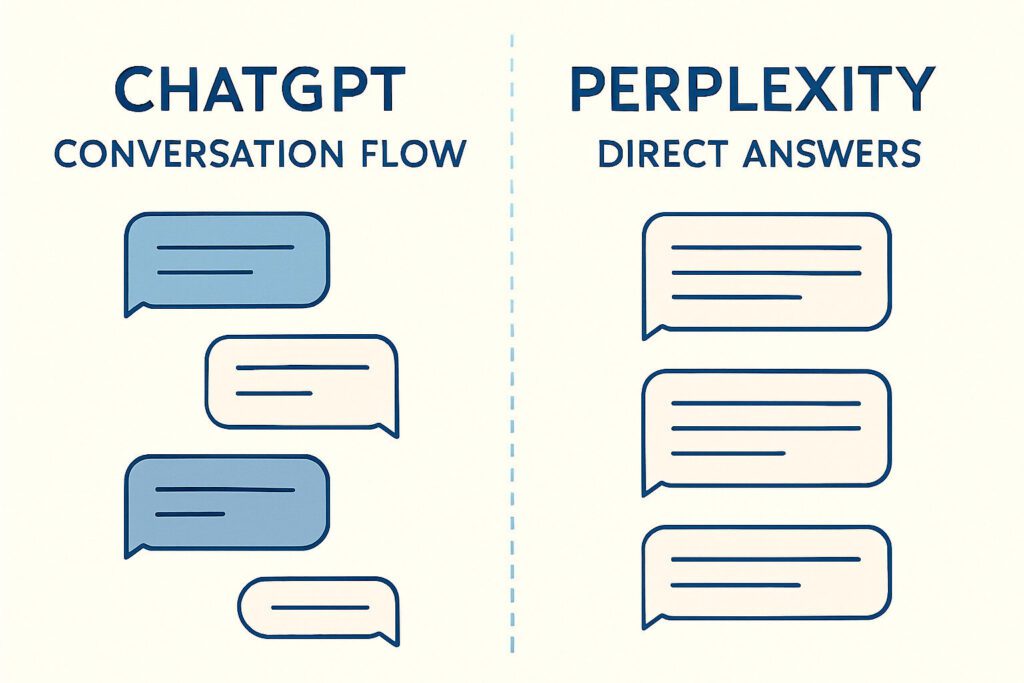
ChatGPT shines for natural dialogue. Its conversational tone is fluid and intuitive, perfect for customer service scripts, brainstorming sessions, or exploring ideas through back-and-forth discussion.
Perplexity prioritizes directness over conversation. You’ll get straight, factual answers, but it’s not built for the kind of deep, exploratory dialogue that ChatGPT excels at.
In short: Perplexity is best for answers. ChatGPT is stronger at discussions.
Content Creation and Brand Customization
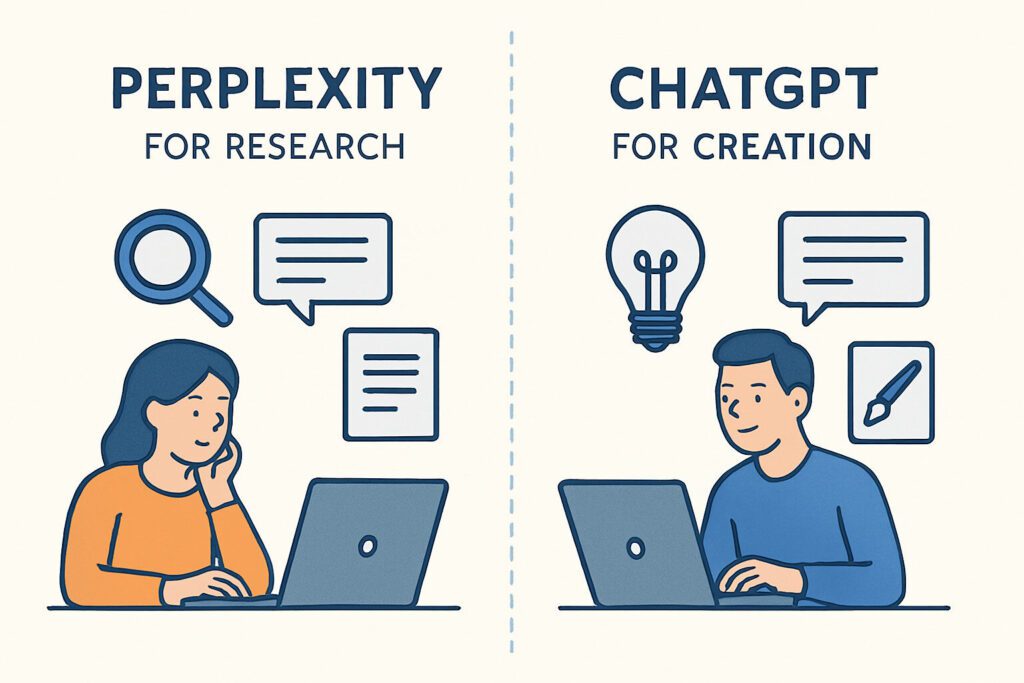
ChatGPT is the clear winner for creative work. Blog posts, social media copy, ad campaigns, it handles them all with natural flair. Custom GPTs let you fine-tune tone and style to match your brand voice perfectly.
Perplexity focuses on fact-heavy content. If you’re writing research reports, white papers, or anything requiring extensive citations, Perplexity delivers accuracy over creativity.
Imagine checking your blog engagement in 30 days after switching to the right tool for your content type…
Coding and Technical Support
ChatGPT excels at hands-on development work. It generates code snippets, debugs issues, and explains complex programming concepts across multiple languages. It’s like having a coding partner available 24/7.
Perplexity can answer code-related questions but isn’t designed for interactive troubleshooting or debugging sessions.
Privacy and Data Handling
Perplexity prioritizes privacy and doesn’t train on user data by default. If data security is non-negotiable, Perplexity offers stronger default protections.
ChatGPT has privacy protocols but requires closer attention to data usage policies, especially when handling sensitive business or personal information.
Use Case Deep Dive: Which Tool When?
Research and Academic Work
Choose Perplexity. If you’re writing a thesis, researching a story, or building a business case, Perplexity’s citation-backed answers are invaluable. The ability to verify every claim and trace information to its source is a research superpower.
I find students and journalists consistently prefer Perplexity because it eliminates the fact-checking step, the sources are already there.
Content Creation and Marketing
Choose ChatGPT. For blog posts, social media content, brainstorming campaigns, or any creative writing task, ChatGPT’s natural language capabilities and creative flexibility make it the obvious choice.
Financial Analysis and Market Research
Perplexity is gaining ground fast. With real-time stock quotes, earnings reports, and live market data, Perplexity is positioning itself as a serious alternative to traditional finance tools. Its live data access gives it a decisive edge for market analysis.
Coding and Technical Problem-Solving
ChatGPT remains the go-to. Developers consistently rate ChatGPT highly for coding assistance, debugging, and technical explanations. Its ability to understand context and generate working code across languages is impressive.
Everyday Questions and Learning
It depends on your priority. For quick factual questions where accuracy matters, Perplexity’s cited answers provide reassurance. For learning complex concepts through conversational exploration, ChatGPT’s explanatory style is excellent.
Pricing: Surprisingly Identical Structures
Here’s the good news: both tools use the same pricing model, making direct comparison easy.
- Free tier with usage limitations
- $20/month for pro features
- $200/month for enterprise-level access
You can test both without spending a dime, which makes it easy to discover which one fits your workflow better.
The Ultimate Decision Guide: Who Wins For You?
Choose Perplexity AI if:
- You’re a researcher, student, or academic who needs accurate, cited information
- You work in finance, journalism, or any field where current data is crucial
- You’re tired of fact-checking and want sources built into every answer
- You need to compare multiple sources quickly for decision-making
- You’re writing reports or academic papers requiring proper citations
Choose ChatGPT if:
- You’re a content creator, marketer, or writer who needs creative assistance
- You’re a developer who needs coding help and technical support
- You want a conversational AI partner for brainstorming and problem-solving
- You need help with everyday tasks like email writing, summarization, or learning
- You value natural, human-like conversation over pure factual accuracy
The Power User Secret: You Probably Need Both
This is where most strategies completely backfire, trying to force one tool to do everything.
Many professionals use Perplexity to gather fresh, reliable data, then switch to ChatGPT to analyze, rephrase, or structure that information. This combination blends accuracy with creativity, turning verified facts into compelling, readable content.
Score yourself 1-10 on how often you verify AI-generated information before using it. If you’re below 7, you need Perplexity in your workflow.
What Happens Next: Your Action Plan
Remember:
- Perplexity is best for research and verification – not creative brainstorming
- ChatGPT excels at conversation and content creation – especially when accuracy isn’t time-sensitive
- Citation transparency matters more than you think – but only if your work requires verifiable sources
This week, implement just ONE strategy: Pick a task you do regularly (research, content creation, or coding) and test the recommended tool for that specific use case. Check your results in 7 days.
But here’s what this guide couldn’t cover: how to combine multiple AI tools into a seamless workflow that eliminates redundant work and maximizes output quality. The strategies that top-performing teams use require specialized knowledge about AI orchestration that goes beyond basic tool selection…
While these strategies work brilliantly for individual tasks, imagine having multiple AI assistants simultaneously optimizing your research, content creation, and analysis, each trained on different data sources and specialized for specific outcomes. That’s exactly what we’ll explore in the advanced AI workflow guide…
Looking for more AI options? Check out our guides on the best AI tools and alternatives to ChatGPT that can supercharge your workflow!
Keep Reading: Claude vs. ChatGPT