You’re mid-conversation with ChatGPT. It’s going well. But you need Claude’s perspective on the same problem.
So you open a new tab. New login. And now you’re copy-pasting your entire conversation history just to give Claude the context ChatGPT already had.
Then you want to check what Gemini thinks. Another tab. Another re-explanation.
You’ve just spent 15 minutes managing chatbots instead of solving your actual problem.
This happens every day. Multiple times a day. And it’s costing you over 3 houts of productive time, all because AI chatbots don’t talk to each other.
What if you could switch from GPT to Claude to Gemini, all in the same conversation, without losing your context?
Here’s how it works and why it matters for your workflow.
How Much Time You Lose Switching Between aI Tools (The Real Numbers)
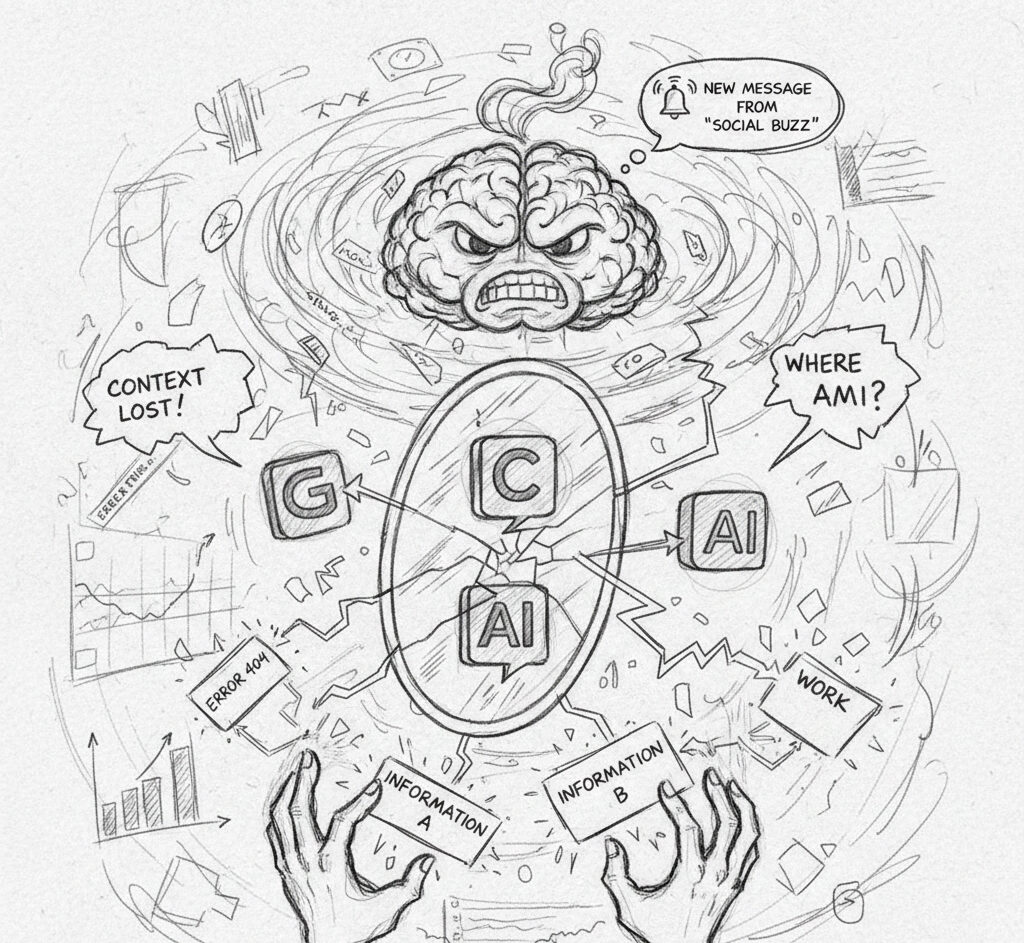
Here’s something nobody talks about: you’re losing 40 minutes every single day just switching between AI chatbots. That’s not a typo. Forty. Minutes. Every. Day.
Think about it. You’re working on a complex project and need strategic advice. You ask ChatGPT. It gives you one perspective. You need a second opinion, so you open Claude in a new tab. Different chatbot, different login, and, here’s the killer – you have to re-explain your entire context. Then you think, “What would Grok say about this?” So you switch again. Copy. Paste. Re-explain. You get yet another take. Now you’re comparing three different responses, trying to figure out which one is actually right for your situation.
Over a week, that’s 3.3 hours, basically a full workday, just switching between chatbots. Over a year? You’ve lost nearly two full weeks of productivity to the switching tax alone.
And here’s the kicker: it’s not just time. It’s cognitive load. Your brain is constantly context-switching, which means you’re never fully in the zone. You’re always partially thinking about which chatbot to use next, whether it’ll understand what you meant last time, and whether you need to copy-paste your entire conversation history just to get a coherent answer.
Why You Can't Use Multiple AI Chatbots Without Losing Context
Let’s be honest: the current AI chatbot landscape is a mess. You’ve got:
ChatGPT for general questions (but it forgets everything when you switch away)
Claude for nuanced analysis (but you have to re-explain your project from scratch)
Microsoft Copilot for integrated workflows (but it doesn’t know what you just discussed in ChatGPT)
Grok for real-time information (but it’s yet another login, yet another lost context)
It’s like having a different consultant for every decision, except none of them ever read the meeting notes. ChatGPT doesn’t know what Claude just told you. Grok doesn’t know your project history. Microsoft Copilot doesn’t know your preferences.
Your chatbots are like a committee that never meets. They’re all smart. They’re all capable. But they’re all working in silos. And every time you switch, you lose your context.
And the worst part? You’re the project manager. You’re the one holding all the context in your head. You’re the one explaining the same thing over and over. You’re the one copy-pasting conversation histories between tabs, hoping the new chatbot will understand what the previous one was talking about.
The Real Cost of Inconsistency
Imagine you’re a consultant preparing a client proposal. You ask ChatGPT to analyze market trends. It gives you solid insights. But you want Claude’s perspective too; it’s better at nuanced analysis. So you open Claude. New tab. New login. And now you’re copy-pasting your entire conversation from ChatGPT into Claude just to give it context. Then Claude gives you different insights. Different tone. Different recommendations.
Now you’re second-guessing yourself. Which analysis should you present to the client? And worse, you’ve just spent 15 minutes managing chatbots instead of actually thinking about the strategy.
Or you’re a business strategist. You start a competitive analysis in Microsoft Copilot. It gives you one perspective. You want to cross-check with Grok for real-time market data. You switch. You lose your context. You re-explain. Different data. Different conclusions. Now you’re spending hours reconciling the differences instead of actually making the strategic decision.
This isn’t just annoying. It’s expensive. It’s error-prone. It erodes trust in AI when it should be building it.
How to Switch Between GPT-4, Claude, Gemini and Way more Chatbots in One Conversation
What if you didn’t have to switch chatbots at all? What if you could switch between different LLM models: GPT-5, Claude, Grok, whatever you need, all within the same conversation, with your context intact?
That’s exactly what OpenCraftAI does.
Instead of juggling multiple chatbots, OpenCraftAI gives you multiple LLM models in one unified platform. You’re working on a project. You ask a question using GPT-5. You get an answer. You want Claude’s perspective on the same issue? Just switch the model. Your entire conversation history stays right there. No copy-pasting. No re-explaining. No lost context.
It’s like having a team of expert consultants who all sit in the same room, read the same briefing documents, and can seamlessly hand off to each other without you having to repeat yourself.
What Persistent Context Means (And Why It Saves over 3 Hours per Day)
For Business Strategists
You’re developing a market strategy. You start with GPT-5 for analytical reasoning. Mid-conversation, you want Claude’s nuanced perspective on a specific point. You switch models. Your context persists. Claude picks up exactly where GPT-5 left off. No re-explaining. No starting over. You get the best of both models without the switching tax.
For Consultants
You’re preparing client recommendations. You use multiple models to verify your thinking; GPT-5 for structure, Claude for depth, maybe another model for specialized analysis. All in the same conversation thread. All with full context retention. It’s like having three expert consultants reviewing your work simultaneously, all reading from the same brief.
For Content Creators
You’re writing thought leadership pieces. You need GPT-5 for structure, Claude for nuance, and maybe another model for fact-checking current events. Instead of opening three different chatbots and losing your creative flow, you switch models within OpenCraftAI. Your draft stays intact. Your ideas stay connected. You stay in flow.
For Researchers
You’re analyzing complex topics. You want multiple perspectives from different models. With traditional chatbots, you’d open multiple tabs, copy-paste your research context into each one, and manually compare outputs. With OpenCraft AI, you switch models and ask the same question. Each model sees your full research context. You get diverse perspectives without the context-switching nightmare.
For Anyone Else
You’re not losing 40 minutes a day to chatbot-switching. You’re not re-explaining your context. You’re not managing multiple logins, multiple tabs, multiple conversation histories. You’re just… working. With the right model. At the right time. With your context always intact.
OpenCraft AI vs. Using Multiple Chatbots: Side-by-Side Comparison
Here’s what makes OpenCraft AI fundamentally different: your context persists across model switches.
Let’s say you’re working on a complex business problem. You start with GPT-5. You have a 20-message conversation building up context, background, constraints, and goals. Then you want Claude’s perspective on a specific aspect.
With traditional chatbots: You open Claude in a new tab. You copy-paste the relevant parts of your GPT-5 conversation (or worse, you try to summarize it). Claude gives you an answer, but it doesn’t have the full context. You get a partial perspective. You switch back to ChatGPT. You’ve lost 10 minutes and your train of thought.
With OpenCraft AI: You click a button. You switch from GPT-5 to Claude. Your entire 20-message conversation is right there. Claude sees everything. It understands the full context. It gives you a nuanced answer that builds on what GPT-5 already said. You switch back to GPT-5 if you want. Your context is still there. You haven’t lost a single second to context management.
That’s the difference. That’s the game-changer.
The Irony of AI Fragmentation
Here’s the thing that gets me: we built AI chatbots to reduce friction in our work. To make us faster. To handle the thinking so we could focus on the strategic, important decisions.
Instead, we created a new kind of friction. Now we’re spending time managing the chatbots instead of using them. We’re copy-pasting between tabs. We’re re-explaining context. We’re losing our train of thought every time we switch tools.
It’s like we brought in helpful consultants, but put them in separate buildings and banned them from talking to each other. So every time you want a second opinion, you have to walk to a different building and start the entire briefing over again.
OpenCraft AI fixes that. It puts all the consultants in the same room. It gives them the same briefing. It lets you switch between them seamlessly. Your context is the constant. The model is the variable.
The Numbers Don't Lie
40 minutes per day lost to chatbot-switching
23% productivity loss from constant app-switching
8% of total work time spent on tool management instead of actual work
That’s not just inefficiency. That’s a business problem. That’s money on the table. That’s strategic thinking not happening because you’re too busy copy-pasting between ChatGPT and Claude.
Why Now?
It’s October 2025. AI adoption is everywhere. Every professional is trying to figure out which chatbot to use—ChatGPT for this, Claude for that, Grok for real-time stuff, Microsoft Copilot for integration.
But here’s what nobody talks about: the switching cost is killing your productivity.
You’re not just switching tools. You’re switching contexts. You’re losing flow. You’re spending cognitive energy on tool management instead of actual thinking.
The smart professionals are consolidating. They’re moving to platforms like OpenCraft AI that eliminate the switching tax. That maintain context. That let you use multiple models without the fragmentation headache.
Because here’s the truth: the best AI tool is the one you don’t have to think about. It just works. It remembers your context. It lets you switch models when you need different perspectives. It never asks you to repeat yourself
Ready to Stop the Madness?
If you’re tired of:
Losing 40 minutes a day to chatbot-switching
Copy-pasting conversation histories between ChatGPT, Claude, Grok, and Microsoft Copilot
Re-explaining your project context every time you switch tools
Managing multiple logins, multiple tabs, multiple conversation threads
Never being fully in the zone because you’re always partially thinking about which chatbot to use next and how to transfer your context
…then it’s time to try OpenCraft AI.
It’s not just another AI chatbot. It’s the unified platform that gives you multiple LLM models with persistent context. Switch from GPT-5 to Claude to any other model in your toolkit – your conversation stays intact. Your context persists. Your flow remains unbroken.
Stop juggling. Start working. Explore OpenCraft AI today and reclaim those 40 minutes. Your brain and “your productivity” will thank you.
OpenCraft AI is an India-based AI startup building smarter, more efficient AI solutions. We’re focused on making AI work better with real-world data. Follow our blog for more insights into emerging AI technologies explained in plain English—no jargon required.